
9 Media and democracy
Mary Griffiths
Key terms/names
Actors, agenda-setting, Australian Communications and Media Authority (ACMA), audience segmentation, convergence, digital disruptions, fake news, Federal Parliamentary Press Gallery, fourth estate, global technology platforms, hyper-mediation, journalist–source relations, mediation, mediatisation, mixed economy, neutrality, ownership, partisanship, public interest journalism, public relations and spin, regulation and self-regulation, remediation
For media researchers and students, the key questions endure: who is speaking, for whom, through which conventional formats, on which platforms and for what purposes?
In transitional times for media, answering these questions is not easy. A free press, independent of government and monopoly control, is an essential component of a liberal democracy, and a nation’s oversight of media ownership, sector diversity, regulation and accountability is critical to the health of its governance. Any proposed limits on media’s freedom to operate as the citizens’ watchdog on the state rightly attract public attention and, often, fierce argument. Frequently, tensions arise between civil society’s stated belief in free speech – as a principle – and the public’s ready acceptance of its practice, and likely political outcomes.
The material conditions under which media organisations once operated have altered with high concentrations of ownership technologies. Widespread consumer participation, information abundance, hybrid content and converging platforms and formats have also emerged as important features of the contemporary media landscape.
But these features of the changing mediascape are only part of the picture. In the last three years, particularly during the 2022 election campaign, a public view is being expressed that influential parts of Australian media have lost the neutrality expected of public interest journalism, and instead have become partisan actors in political processes. Inevitably, questions arise about whether a significant shift in Australian media practices has taken place, and whether media are still fulfilling the role in liberal demoracy that citizens expect them to play.
This chapter covers the transformation of media and its impact on political culture. Mediation and the pre-digital democratising communication technologies – print, radio and television – are the initial topics discussed, followed by an account of the increased public participation enabled by digital technologies. The chapter then maps the Australian media sector. The mixed economy approach that Australia takes to media policy and regulation is summarised, before the chapter returns to the free press concept, concluding with an overview of parliamentary media and the potential problems inherent in journalist–source relations.
Mediation
Mediation is the core of inquiry in media scholarship. It involves analysis of the whole or of selected aspects of the material processes of production, distribution and reception of media content, and the construction of specific audiences, institutions, practices and technology uses.
Mediation theory argues that representations of the world do not unproblematically reflect its realities. Representations are treated as constructs formed by sets of practices, codes and compositional conventions from which we, as consumers, actively make meanings. For example, different levels of familiarity with the basic television news format – authoritative ‘talking heads’ (hard news, sport, weather), remote vision, voice-overs – veil or partially obscure the myriad forms of agency required to construct a ‘seamless’ flow of news.
Viewers’ cues about potential meanings are derived from camera positions, live reports versus automated feeds, or editing processes that, for example, truncate a serious policy announcement to give prominence to an amusing but tangential moment. News readers’ modes of address are regularly fine-tuned by internal research on viewer profiles; thus the seemingly inconsequential interactions between co-hosts help audiences attribute significance to a story.
Mediating processes combine technical, journalistic, political, ethical, editorial, commercial and platform- or audience-driven elements. Whatever the technology (print, telegraph, camera, radio, television, satellite, the internet, mobile, smart), media are never just mirroring reality. Their forms are implicated in the existence and survival of cultural, economic and political systems. Thus, questions of power and agency in mediation processes are critical when considering media.
Mediatisation
Theorists of media argue about the nature and impact of mediation processes, and about the logics, rituals and patterns evident in what is called the mediatisation of politics. The concept is complex but useful. It focuses on media and politics as separate but interrelated domains that are directly and indirectly capable of shaping major societal change. Mazzoletti and Schulz discuss the usurping of political power, seeing media as a potential threat to democracy.[2] For Strömbäck, media logics compete with the logics of politics.[3] He defines four distinct stages in the power dynamic between actors. Mediatisation is also being explored by theorists in relation to other institutions. It requires more analysis than is possible here. Asking precise questions about how – specifically – media transforms political action is always useful.[4]
Technologies: from print to digital disruptions
Communication technology plays a generative role in anchoring normative societal attitudes in any era. Print technology commanded the flow of political information through centuries of development in Western democracy, just as, from the mid-20th century onwards, radio and television helped form mass political literacies – the ways people understand the world and understand politics. Digital and smart technologies are replacing or colonising heritage media.
The decline of print news
The fragmentation of heritage media started towards the end of the last century, when print newspapers began to lose their advertising revenue, and then their audiences, to the internet. Print news’ dominance has gone, along with the shared ritual of reading the paper at set times of the day – a practice that had helped individual citizens in a nation-state to see themselves in a ‘deep horizontal comradeship’ with others[5] and to form civic competencies.
Newspaper readerships improved slightly during the 2020–22 pandemic years; nevertheless, overall print readerships now count for less than half of online readerships for mainstream content. Though many print mastheads have vanished,[6] some survivors remain politically influential. The Australian, for example, has a relatively low circulation, compared to past years, but retains a capacity to influence Australian news and commentary. Roy Morgan recorded a rise in readerships for cross-platform news for the year from March 2017.[7] Sydney-based news topped the list: The Sydney Morning Herald and The Daily Telegraph. Melbourne’s The Age and Herald Sun came next, followed by the two national papers, The Australian (which, with a 4.9 per cent rise, had increased its Sydney readership) and The Australian Financial Review.
Online news and opinion
The internet changed everything for print and broadcast media. Media and consumers were finally free of the scheduling limitations imposed by print presses and analogue technology.
But the digital editions of print mastheads face severe competition for eyeballs from local, national and global online competitors, and especially from start-ups with no infrastructure renovation costs. Infotainment, clickbait and ads flourish primarily on commercial media, competing with front-page ‘hard news’ – stories on politics or international affairs. News rooms employ online content producers, using tracking tools to detect even minute changes in reader engagement, while journalists are decreasing in number,[8] and investigative journalism is expensive.
There are gains and losses to digital disruption. It can be generative and initiate innovation, but it often impacts negatively on legacy media, readerships and workforces if they cannot rapidly adapt.
Across the hybrid digital platforms, media content is created, repurposed and often categorised as ‘premium content’ behind subscriber paywalls. Journalists adapt stories while events are unfolding or compete for a unique selling point after tracking interest in trending stories. The editorial capacity to add and withdraw digital content may also be partly responsible for the pressure on journalists to publish first and amend later. The volume and apparent liquidity of news content could potentially unsettle a reader’s grasp of the chronology and significance of events.
Freely accessible subscription-based digital newspapers, on the other hand, have increased the number and diversity of voices being heard. Guardian Australia has no print edition, for example, but ranked fifth for news readerships in 2021.
A tutelary attitude is discernible in the accumulation of hyperlinks to earlier or complementary news stories, and in reader aids such as the ‘story so far’ column. ‘Opinion’ writers no longer rely on prior knowledge or experiences shared with readers, as their arguments can be supplemented by links to supporting content. Journalists now also self-reference or draw attention to colleagues’ work.
Hyper-mediation
Information flows 24/7 on free-to-air and subscription-only platforms, viewed in private on a range of fixed and mobile devices and as the background noise and vision in public spaces. The intense barrage of connected content (graphics, video, social media, hypertext) within even one story is inescapable and yet, despite media’s ubiquity, consumption patterns are not shared as they were in the era of mass media. Fragmenting media organisations; innovating, inexpensive digital start-ups; the reduction of media workforces; and the segmentation of audiences into ever narrower slices of the total audience ‘share’ are dramatically altering the landscape.
Sophisticated tracking tools map individual digital usage patterns to give powerful organisations like NewsCorp and Nine real-time insights into consumer behaviour. The data are used to segment audiences into recognisable tribes for newsroom content, which can be packaged by interest and income and re-sold to other brands for micro-personalised marketing.[9]
In summary, though individuals are easily navigating digital media even while mobile, more is known about each person than ever before by external agencies, their choices are potentially isolating them and they may lack significant points of contact with others. Governments and political parties, on the other hand, have found it hard to adjust their communications to hyper-mediation and to social media’s empowerment of citizen-consumers. The scattergun approach of repetitive messaging across multiple platforms for comprehensive coverage easily backfires, but so too does data-driven personalised messaging.
Trust, blame, the ‘Canberra bubble’ and ‘toxic politics’
Media is increasingly blamed for the toxic nature of contemporary political culture in Canberra and for undermining trust in democracy. Dissatisfaction with democracy, as tracked by the Australian Election Study (AES) since 1997, reached an all-time high among voters in 2019.[10] Fairfax reported AES findings at the time, subsequently initiating a reader poll on reasons for the state of Australian democracy.[11] Blame was primarily directed at politicians, the electoral system and mainstream media.
Summarised poll comments from the AES identified four main concerns about media’s contribution to the state of affairs: a focus on conflict and negativity, partisanship, clickbait and not holding politicians to account. The four concerns seem indicative of broader public judgement. The two terms ‘Canberra bubble’ and ‘toxic politics’, circulating since the beginning of the decade-long leadership spills in both major parties, have been used more frequently following the allegations made by Brittany Higgins at the Women’s March in 2021, and in subsequent reporting of other allegations of serious misconduct in Parliament House, involving senior politicians and staffers. The first term works as shorthand for a self-interested governing elite perceived to be out of touch with citizens’ concerns. The second term has become a recurring narrative in hard news and opinion commentary.
Partisanship
Partisanship is not new in the history of media[12] but the corporate media institutions of today are expected to differentiate clearly between hard news and opinion columns. Journalists are now regularly accused of permitting ideological bias to distort news coverage; of misrepresenting government policy and actions; of being stooges of or echo chambers for particular parties and politicians; of producing fake news; of fuelling social divisions; and of crossing the line into political activism. These assertions are not always supported by substantive evidence and may be put forward for political reasons, but their repetition contributes to a discourse of media’s failure to perform its ‘fourth estate’ public interest role. Australian journalists have been subjected to threats, exclusions, online trolling, police searches and even violence.
That said, a 2020 study found that while Australians retain high levels of trust in the public broadcasters ABC, SBS and (the only newer source noted) Guardian Online, they wanted bias and conflicts of interest to be addressed more accountably, a clearer line to be drawn between news and opinion, and media organisations to look at improving internal journalism cultures.[13]
Accusations of political activism in sections of the media were voiced in 2018 by, among others, Nine’s chief political reporter;[14] the editor-in-chief at Guardian Australia;[15] and former Liberal[16] and Labor prime ministers.[17] Kevin Rudd’s petition for an inquiry into Murdoch’s media drew half a million co-signatories. The retaliation from News Corp was swift, with orchestrated personal attacks directed at the former Prime Minister, illustrating similarity in editorial content across NewsCorp outlets.
As the Eastern states went into extended lockdowns in 2020–21, social media’s circulation of conspiracy theories and unsubstantiated claims about vaccines ramped up unchecked, further endangering public trust in mainstream news and in public leaders, including medical authorities. When SkyNews reporters and others pursued the Victorian Premier at the height of the pandemic lockdowns, a number of hard news journalists became ‘actors’ themselves, in what were, arguably, attempts to wield political agency in the state’s decisions about public health restrictions. The line between reporting and opinion had blurred unhelpfully for citizens, yet the Victorian government retained popular support as a fierce Twitter backlash mobilised in defence of the state’s leaders.
The trust factor re-emerged during the 2022 federal election, triggered by memories of the perceived lack of even-handedness in coverage of the 2019 election.
When ex-Prime Ministers (Kevin Rudd, Malcolm Turnbull), public figures (Quentin Dempster, Gay Alcorn) and ex-News Corp journalists (Tony Koch) identify bias in a media conglomerate with Australia’s largest audience share, public concern is inevitable. The ABC’s Media Watch’s ‘Election ‘22’ documents the lack of equal attention given to the two major parties by News Corp mastheads in Brisbane, Melbourne and Sydney.[18]
The public broadcaster itself has not been immune from perceptions of bias: particular appointments to its board have drawn criticism, and a Twitter watch (largely from the left of politics) monitors suspected agenda setting, news frames and commentary from a select number of ABC News journalists, and the hosts of the key public interest programmes, 7.30, Q A and Insiders.
Whether objective ‘public interest’ journalism, once the mainstay of mainstream news, can survive without government funding is an ongoing concern.[19]
Increased participation
Streams of content originating in separate production processes blend at the point of consumption as end-users control the news feeds they receive, reproduce and annotate. Consumers become curators when blogs and social media give them the agency to select and prioritise the content forwarded to newsgroups and niche publics.
A user may be regularly annotating and forwarding content to like-minded groups, and individual agency can be co-opted. Influencers emerge by remediating content, and the editing process on social networks is rarely as transparent as Wikipedia’s.
Social media site analytics demonstrate the rising popularity of new public spaces for political discourse on major digital platforms. Page views to staffing ratios show they can be a sustainable model of public interest journalism. Reception to independent Australian news publishers has been mixed. Attention is limited by the challengers’ capacity – relative to mainstream media (MSM) – to be sustainable, maintain eyeballs, and regularly post trusted, relevant content.
Michael West Media (MWM) has a public interest focus on ‘the rising power of corporations over democracy’. Staffed by six journalists with analysis provided by a score of commentators, the website scrutinises the detail and likely outcomes of legislation, advocating for improved accountability, media diversity and equity. It had 412,700 visits in April 2022; Crikey had twice MWM’s visits with 12 staff.
Michael West Media
‘We are non-partisan, do not take advertising and are funded by readers. Our investigations focus on big business, particularly multinational tax-avoiders, financial markets and the banking and energy sectors.’
Michael West Media[20]
In 2016 Michael West, the founder of Michael West Media, was a senior editor and investigative journalist working for Fairfax Media (now Nine), having spent eight years at Murdoch’s The Australian. Losing revenue, Fairfax began forced staff redundancies and a business model critiqued by some employees, based on what West and others called ‘clickbait’ content. One of an estimated 30 journalists sacked in May that year, West went public with his view that, in the move downmarket, Fairfax Media had damaged its own longer-term future, as well as the future of high public interest journalism in Australia.
By July he had founded MWM, committed to independence, continuing to investigate big business and report critically on public policy issues. West’s award-winning investigations have triggered two Senate Inquiries into corporate malfeasance. On 13 July 2022, MWM published a story focused on the legality of sacking of 2000 employees from Australia’s national airline despite its taxpayer bailouts, titled: ‘Qantas Smiles: shareholders and executives grin, customers and staff grit their teeth.’
MWM’s watch-dog coverage of government, media partisanship and the corporate world is well-researched, funded by reader contributions, and is free to access. A small team of paid journalists is supported by contributors, including news editors, journalists, former diplomats, activists, academics, and a range of experts in tax, banking, politics, and climate science. The West Report, analysis of significant points of public interest, is published regularly on YouTube.
Social media disruptions
Twitter’s strengths and weaknesses can be illustrated by the example of Trump’s White House Twitter feed through 2018. Social networks give already powerful politicians and their media advisers even bigger megaphones, with access to global audiences. Politicians circumvent mainstream media by speaking directly to those they perceive to be their publics on social networks, ignoring journalists and escaping difficult questions.
Regular social media interactions appear to close the distance between government and governed, but can also cause uncertainty and result in limited accountability. However, Malcolm Turnbull’s Twitter account rebutted The Australian’s negative coverage of his post-spill actions,[21] and Anthony Albanese used Twitter to rebut interpretations of election campaigninteractions with journalists. Amplified by commentary from other media, both responses demonstrate social media’s potential for unsettling dominant media narratives.
Citizen journalists and information warriors attack mainstream media’s framing of contentious events and are usually avowedly partisan analysts. During Australian anti-vaccine protests in 2021, major cities experienced US-style hyper-partisan independent reporting when populist activists live-streamed protest events for social media. In one case, the doors of Old Parliament House, which now houses the Museum of Democracy, were set alight.
Rebel News Australia was visible and partisan during the protests. The site recruits paying followers targeted through specific causes. Its presenter, Avi Yemeni, uses familiar journalism techniques (such as recording tussles at protests, conducting vox pops, editorialising to camera, profiling supporters) but the resulting content is posted to social media platforms without any evidence of the even-handedness or fact-checking commitment expected in traditional public interest journalism.
Rebel News Australia
‘We see that the mainstream media pretends to be impartial, but they increasingly behave like political parties. They don’t admit their own political bias, and they pretend to be neutral providers of the news when they are anything but.’
Rebel News Network Ltd.
Rebel News Australia (RNA) is part of Canadian-based, crowd-sourced Rebel News Network Ltd., a conservative opinion and activist site with hard-right links, founded by ex-Sun Media journalist Ezra Levant in 2015. Presenting itself to subscribers as willing to take on any story, organisation or government without fear or favour, it targets the establishment, including the mainstream press and the ‘Media Party’, whatever the ostensible focus of its issues-based content. Initially operated solely by Levant as his mouthpiece on provincial politics and anti-Muslim themes, the network’s anti-woke, anti-climate change views and links to alt-right activist groups have attracted diverse anti-establishment followers, particularly those disenchanted with traditional political parties.
Censured by Canadian Prime Minister Justin Trudeau for misinformation during national elections, Rebel News’ negative coverage of COVID-19 public health measures and its divisive reporting of public events have earned it comparisons with alt-right US publication Breitbart News. Alt-right connections with the Proud Boys (by employing its founder as a contributor) led to boycotts by the Conservative Party of Canada, and grassroots campaigns for the withdrawal of corporate advertising.
Currently Rebel News Australia (RNA) is staffed by Avi Yemeni. Once a sniper with the Israeli defence forces and a former gym owner, Yemeni describes himself as a ‘citizen journalist’, a claim other independent journalists dismiss, suggesting alternative descriptors such as agitator and activist.
Yemeni’s legal past includes a domestic assault conviction, a fact frequently referenced by opponents. In 2022, following a heated Twitter exchange, Yemeni launched a defamation suit attempting to unmask ‘PRGuy17’, an anonymous, popular left-wing Twitter user whom Yemeni suspected of being a shill for the Victorian Premier, Daniel Andrews.
Two points need to be made: first, anonymity is defensible in a democracy because, for many of those wanting to speak truth to power, it may protect their safety and well-being; second, the use of defamation as a political weapon has resulted in legislation being passed against what are known as intimidation lawsuits in Canada, Rebel News’ base, known as Strategic Lawsuit Against Public Participation or ‘anti-SLAPP’ laws. In Australia, the Protection of Public Participation Act 2008 (ACT) is a local example of such legislation.
In the Yemeni v Twitter case, the arguments about the intersection of individual rights (freedom of speech versus the right not to be misrepresented) were politicised off-stage by the social media actors involved and their respective supporters. Consequently the debate of this significant public interest issue became unfocused, as pre-existing antagonisms were re-activated. Twitter was forced by the Federal Court to hand over the details of the pro-Labor account (PRGuy17), and Yemeni was ordered to stop further action. Before Yemeni could re-deploy the information, PRGuy17 outed himself in a FriendlyJordies video, proving not to be the ‘secret government operative’ of Yemeni’s conspiracy theory but a private citizen, Jeremy Maluta. Maluta declared, ‘I’m a regular Aussie guy who is passionate about truth in journalism, social justice and the ability for all of us to speak up.’ Independent Australia’s Tom Tanuka points to the connection between Rebel News’ legal cases and its fundraising drives.
From the left of politics, FriendlyJordies (FJ) further illustrates the pros and cons of social media’s polarised voices. Started by Jordan Shanks in 2013, FJ offers satirical political commentary across multiple social media sites. It has broken detailed stories on corruption in government, but this content has largely been ignored by mainstream news. Self-professed as left-leaning, FJ has a younger YouTube following,[22] where the presenter’s style – a combination of investigative citizen journalism, obsession with press freedom, honed digital skills, and entertaining, energetic chutzpah – first became popular. With 405,000 YouTube subscribers (trending up over the 2022 election) and 106,886 unique daily views on 15 May 2022, overall views of over 90 million, 106,900 Twitter followers, 95,300 Instagram followers, a Facebook profile noting 345,000 followers, FJ’s readerships are engaged and politically literate with issue-based interests. Attempts by its high-profile political targets to silence FJ have drawn political and mainstream media blood. However, the site has proven more resilient to external pressures than mainstream media, and more versatile when cementing allegiances with other partisan influencers.
FriendlyJordies (FJ)
‘It’s combining your natural skills with a public service. I think it’s a good thing to do. It keeps you sane.’
Jordan Shanks interviewed by The Daily Mail, UK. [23]
Jordan Shanks, founder of the FriendlyJordies (FJ), has risen to prominence as a political commentator, as social media platforms enabled the growth of diverse publics for public affairs discourse. He creates slick media shows investigating contemporary issues of serious public interest, using graphics, cartoons, news clips, jokes, and edgy commentary. The content focuses on identifying possible political corruption, scandals, and leaks about the inappropriate conduct of those in public life. This mix has made Shanks an enfant terrible for many professional journalists. He has supporters among the independent media, and is seen as an investigative reporter par excellence by his subscribers.
In 2022, FJ posted ‘The Baddest MP: Dutton’ which alleged potentially corrupt connections between a string of private companies, the Australian Federal Police(AFP) and the Liberal Party. This video had over half a million views by July 2022. Shanks’ outspokenness has run afoul of defamation laws –laws which, he argues, were used as proxy weapons to silence political opponents during Scott Morrison’s Coalition government.
Shanks was fined by the Federal Court and ordered to apologise for perceived harassment of NSW Liberal politician, John Barilaro, while Google, was censured for publishing the FJ videos on YouTube, and fined even more severely. Mainstream reporting of the case focused on ‘unprofessional’ journalism practices (a dig at the growing power of independent journalism and social media), the perceived lack of comparative accountability, and the colourful personalities involved.
FJ’s harder-hitting investigations are sometimes followed up by mainstream outlets (mostly unattributed, according to Shanks), or ignored. Shanks, who has a highly interactive social media presence, complains about this treatment to his followers. FJ’s impressive audience numbers on all platforms tend to fluctuate according to a younger demographic’s interest in the single-issue focus of each video. FJ’s YouTube account runs on a subscription model.
Shanks, with a degree in political science, exemplifies a new kind of influence for younger, non-party-aligned members of the polity. He came to political commentary via an eight-year career in modelling and stand-up comedy.
Fake news
Fake news, when it is recognisably sensational clickbait, is familiar to most online users. Well-known individuals and organisations may be regular offenders. Anonymous content simultaneously emerging across several platforms is another red flag. Other telling signs relate to missing elements. A professionally produced news story carries the journalist’s byline and contact details and is date-stamped. Revisions or corrections on subsequent iterations are recorded and disclaimers explain apparent bias or any other diversion from hard news protocols of even-handedness, such as the absence of comment from the subject of a critical story.
Fake news rarely carries such markers. Image altering software can make fakes on social media very convincing, and yet, perversely, content like this is trackable through reverse image searches or through more expert algorithmic analyses. A majority of Australians recognise and make their own choices daily about fake news.[24] In the USA, ‘alternative facts’ or covert political bias in a story can be harder to identify, partly because President Trump normalised attacks on the mainstream media as ‘enemies of the people’.
Publics
Belonging to a public, or many publics simultaneously, is defined by values, mutual visibility and shared interests and activities. Publics can be identified by the communications around an agent, a text or an event. The Institute of Public Affairs’ Twitter feed is an example of a powerful conservative public with a record of climate change denial and radical commitment to freedom of speech. The operation of a horizontal public was exemplified by the Guardian’s live blog of the final day of Australian parliamentary proceedings for 2018. It attracted over 5,500 reader comments on 6 December.
Anyone who is digitally literate can become a disrupter on social media. The online interventions by Russian providers of fake news during US elections in 2016 are regarded as a high-stakes example of state information warfare, although one US party benefitted from their efforts.
Social media participation by politicians, under-resourced parties, activist groups and individual citizens undercuts, and provides copy for, conventional reporting of politics and public affairs. Social media is shared space for politics in action.
The challenges posed by global technology giants
Innovation by end-users is only one way that digital technology is changing Australian political culture. Mainstream news is also challenged by competition from non-traditional technology rivals and start-ups in the news and public affairs marketplace. The social media giants do not pay for the user content that attracts the growth of their subscription bases and profits, yet some content may be profoundly damaging to the public good. More importantly, democracy itself can be weakened by the self-regulated nature and commercial interests of the global platforms.
Calling social media giants to account for the poor quality of the information distributed on their platforms has proved difficult for nation-states. Governments have not designed effective checks, of the kind that uphold the civic rights and responsibilities of a traditional free press, for Facebook and Twitter. The technology companies do not consider themselves publishers; they are not subject to professional publishing codes or state regulations governing news and public affairs journalism.
Facebook still has little accountability for the circulation of, for example, hate speech and fake news on its platform. Like the media organisations discussed in the next section, the tech platforms track and reward users by employing algorithms to measure their activity, find ‘lookalikes’ and predict consumer behaviour.[25] UK democracy watchdog Demos, reporting on political marketing, describes the algorithmic approaches Facebook uses to make audience segmentation more precise through tracking similarities in user profiles.[26] Facebook’s data granularity makes it very effective and not necessarily a good thing. A cautionary tale is provided by the harvesting and exploitation of raw data from millions of unsuspecting Facebook users by the now-discredited political consulting firm Cambridge Analytica for targeted messaging in Trump’s 2016 campaign.
Avoiding engagement with different perspectives is detrimental to a citizen’s democratic openness to rational argument. The social media giants’ operations encourage new social norms, yet they escape accountability: national legislation designed to protect users, and democracy, has no jurisdiction over them.[27]
In any case, avoiding engagement with different perspectives is detrimental to democratic openness to rational argument. The social media giants’ operations encourage new social norms, yet they escape accountability: national legislation designed to protect users, and democracy, has no jurisdiction over them.[28]
Many kinds of ‘free’ information offered by social media platforms and by search engines such as Google come at a transactional cost to users. Data on media consumers is premium information. The new political reality is that information about consumers, the creation of segmented publics or online clusters, and the adoption of sophisticated tools for managing that information all shape political parties’ communication choices.
Mapping the Australian media and communications sector
Australia has a mixed economy approach to media – a combination of private and public enterprise. That said, the concentration of mainstream media ownership is very high, as the regularly updated maps and other information provided free by the Australian Communications and Media Authority (ACMA) illustrate.[29] Every large Australian city has at least one daily newspaper, available in print and digital versions. In 2022, news content reached 97 per cent of the Australian population over 14 years of age.[30] Even in the bush, where broadband access can be patchy, consumers have a choice of free-to-air commercial channels, public channels and paid digital television channels, and sometimes community television. Radio is still important in people’s lives. Local stations, some with small footprints and tiny publics, broadcast ‘news and talk’ about public affairs in every state and territory.
Commercial media
At the macro level, commercial, public and government media broadly define the sector in Australia. Dominant cross-media commercial corporations with significant concentrated holdings and different business emphases compete for market share. Two of these are based in eastern Australia – Rupert Murdoch’s News Corp and Nine – though both own media enterprises or interests across the country. Along with Seven West Media, Kerry Stokes’ holdings and Bruce Gordon’s family-owned assets, they dominate the commercial media world.
News Corp Australia
News Corp Australia’s claim that it is Australia’s number one media company is based on market share and diverse market offerings, with 16 million monthly consumers for its print and digital products.
Their ‘Find your Audience’ webpage is an excellent illustration of the niche market segmentation tools that advertisers, including political marketers, regularly use to match delivery of content to user profiles. News Corp advises that it can connect advertisers to, for example, a group of 1,756,000 consumers labelled ‘Mums, 36, with kids under 18’ or to a market segment of two million ‘Executive Influencers’.
The Australian newspaper is the jewel in the News Corp crown. In terms of circulation figures, it has a combined print and digital audience of 2,787,000 over four weeks. This almost equals Fairfax’s The Age and is just over half of the combined monthly totals for The Sydney Morning Herald.[31] The Australian, which uses paywalls for premium content, has no daily national agenda-setting competitor. The Australian Financial Review, owned by Fairfax Media (see below), is the only other national newspaper.
News Corp’s potential capacity to set an agenda at the metropolitan level is indicated by the dominance of The Advertiser, first established by Rupert Murdoch’s father. It is now Adelaide’s only print daily newspaper. A small subscriber-based digital independent, InDaily, is the sole local competitor for AdelaideNow, The Advertiser’s digital version.
News Corp routinely opposes the current proliferation of online platforms when the opportunity arises to make public submissions. It has argued that the diminishing revenue streams create redundancies and make public interest journalism unsustainable. It was a strong supporter of the new media code which forced Facebook and Google to pay for use of their news content.
Nine
News Corp’s major commercial competitor, Fairfax Media, merged with Nine Entertainment in late 2018, after High Court approval. At the time of the Nine merger, Fairfax had a comprehensive set of media assets, formats and platforms. A newspaper merger with a different kind of media business was regarded as a major shake-up in the sector, generating concerns about the potential loss of a long news tradition of public interest journalism. Fairfax newspapers included the highest-circulation, respected metropolitan ‘broadsheets’ The Age, The Sydney Morning Herald and The Australian Financial Review. Nine has retained these. Fairfax published regional agricultural papers and community newspapers, and Nine sold 160 of these in 2019, prompting concerns about regional readers receiving syndicated rather than local news content. Digital paywalls have now been instituted for The Canberra Times, once freely available under Fairfax.
One hundred and fifty journalists also lost jobs in the merger, but NineforBrands reports that Nine’s total publishing assets reached a de-duplicated audience of 16.2 million Australians across print and digital. Data from December 2021 show that, ‘The SMH is Australia’s most read masthead in the country, with a cross platform readership of 8.6 mill readers.’ In Victoria, The Age’s ‘Good Weekend’ has an average readership of 796,000 and ‘steady growth rates have come from increases in readers 14–24’.[32]
Commercial ownerships, editorial policies, and the marketing tactics used to retain readerships are significant when assessing media’s even-handedness in political reporting, especially any avoidance of robust critiques of government policy.
Public media: Australian Broadcasting Corporation (ABC)
The Australian Broadcasting Corporation (ABC or ‘Aunty’) has a national network of metropolitan and regional stations and offers a range of digital news, entertainment, sports and specialist channels, such as those for children’s programming, youth radio and rural communities. Government funding of about $1 billion annually makes it a significant national enterprise. Commercial media’s criticisms of platform proliferation and defence of private enterprise are arguably thinly veiled attacks on the ease and speed with which the national broadcaster has embraced the digital. At the ABC and elsewhere, workforce contractions and a proposed digital transformation project ensure that controversies over management, funding and direction continue.
A controversial period in 2017–18 ended with the removal of the ABC’s managing director by the board of directors, and then the resignation of the board’s chair. Its own journalists investigated board struggles in the 4 Corners episode ‘Bitter End’.[33]
The ABC Charter,[34] specifically legislated to safeguard the corporation’s independence from government interference, sets high standards for professionalism and fairness. It outlines the broadcaster’s national remit to inform, educate and entertain, and thus animate democracy. Nevertheless, accusations of bias periodically arise. Though the ABC has outspoken commercial rivals and political critics, it remains one of the most trusted institutions in Australian life, as evidenced by regular independent polls. It has a strong supporter base and a distinctive culture.
Public media: Special Broadcasting Services (SBS)
SBS is Australia’s multicultural, multilingual channel. It is a ‘hybrid’ public broadcaster as its funding comes partly from direct grants and partly from advertising revenue. SBS television attracts 13.1 million people monthly and the downloads from radio are high.[35] The SBS streaming service, On Demand, is available more widely than that of any other broadcaster in Australia and makes hundreds of international and Australian movies and programs freely available.
SBS is distinctive in its commitment to Australia’s cultural diversity and strongly promotes intercultural awareness. In 2013, it merged with the media company National Indigenous Television (NITV), whose largely Indigenous staff produce free-to-air content of local and national interest. Reportage of Indigenous perspectives has deepened and diversified, for example, on the preservation of Uluru as a sacred site and on the actions of the first ever Indigenous minister for Indigenous Australians, Ken Wyatt.[36]
Free press in a democracy
Though media operates under pressure within regulatory safeguards, the dynamics of the sector noted above might make the ‘fourth estate’ concept seem archaic.[37] But, in fact, it still resonates broadly in the community and powerfully with many journalists, despite the challenges of redundancies and industry change,[38] and the trust issues mentioned.
The ‘fourth estate’ view of media rests on the principle of freedom of speech. The ‘fourth estate’ view holds that the role of a free media in a democracy is to inform electorates, interpret political events and speak truth to power. Liberal democracies place high value on a fair, strongly independent media – free from censorship or political influence or attack – that willingly acts as a guardian of the public interest.
An impartial press watches over the operations and probity of other institutions, often prompting political action. Stories in 2017–18 about customers’ treatment by Australian banks pressured an initially reluctant government into holding a royal commission into the financial sector. Stories about test kit shortages during 2020 kept the federal government focused on the job of production and distribution, and media reports of job losses, and the difficulties faced by small businesses hastened the introduction of JobKeeper, a federal scheme to retain employment in the sector. Media pay close attention to the administrative arm of government, tracking allegations of misconduct. Coverage of NSW’s Independent Commission Against Corruption (ICAC) proceedings played a decisive part in many voters placing the need for a similar federal body high on their list of most important election issues in the ABC’s 2022 Vote Compass survey. The Australian’s ‘Teacher’s Pet’ podcast, an investigative account of the unsolved cold case of missing woman Lynnette Dawson, might have encouraged new witnesses to come forward and led to the successful prosecution of her husband. Excessive media attention can, however, damage the presumption of innocence.[39]
The important role of a free media is highlighted during election periods. Choosing a government that best serves citizens’ interests depends on accurate information being circulated in a timely, transparent and accountable way. Journalists use a raft of presentation techniques to refresh people’s memories about the past performances of parties and politicians: slogans, file footage, report cards, policy chronologies, infographics, interactive maps and, of course, cartoons. Political cartoonists normally operate outside the defamation framework. Comment is robust. For instance, ‘Stab…ility’, Matt Golding’s conga line of prime ministerial backstabbers, encapsulated a decade of unedifying conduct in Australian politics.[40]
Limits of press freedom
Absolute freedom of expression for the press does not exist anywhere. Even in polities considered liberal democracies, there are nuances. Defence of the principle of free speech was turned into a weapon that several politicians and journalists on the right of politics used to try to silence opposition to proposed amendments to the Racial Discrimination Act 1975 (Cth), specifically to section 18C. The proposed wording aimed to neuter the regulation of racially based hate speech. In 2011, columnist Andrew Bolt controversially, and unsuccessfully, tested 18C in the High Court.[41]
Analysing the fine details of regulatory frameworks and media operational practices is important when defining a liberal democracy. Details to be considered include: journalists’ training and citizens’ expectations; journalism cultures; security restrictions in investigating a government, judiciary or administration; freedom of information processes; defamation law; the existence of legislation protecting journalists; and a government’s informal practices in dealing with journalists’ dissent. Compared to regimes where journalists are censored, imprisoned or assassinated, the conditions for a free press in Australia are still generally good, though vigilance is always necessary.
Media inquiries: monitoring the state of public interest journalism
In May 2018, the report of the Senate Inquiry into the Future of Public Interest Journalism was published. It first assessed changes to news and public interest journalism since the Finkelstein Inquiry five years earlier, before turning to the questions of government funding and a new statutory body with oversight of media – the latter suggestion largely unpopular with media organisations.
The Senate report focused on changes to news caused by the move to a predominantly digital environment. Since Finkelstein, the Senate report noted, the pace of change had exponentially accelerated and, despite the proliferation of new players, the sector’s capacity to fund public interest journalism was being negatively impacted. Challenges included the collapse of advertising revenues and business models, and job losses. Despite recognising media’s challenges, government funding was not recommended. Government thus reaffirmed its reluctance to intervene directly in the mixed media economy. Following a Media Inquiry into fair use of Australian news content by Facebook and Google, the new Media Bargaining Code (2021) was enacted and the tech giants are now mandated to come to a commercial arrangement with local media sources for the use of their content. The code benefits the most powerful actors: NewsCorps, Nine, ABC, SBS, Guardian Australia, and the other large commercial media enterprises; but the financial threshold set for eligibility works against the smaller independent media sources.
The arguments made by Australian news providers included the need to support journalists and public interest journalism. It remains to be seen how mainstream organisations will spend the profits.
Government regulation
Government sets the regulatory framework for the media and communications sector, and various statutory and self-regulation bodies monitor compliance.
The ACMA is the government regulator for broadcasting, the internet, radiocommunications and telecommunications. It recognises the ‘diversity and complexity’ of the Australian media and communications landscape and describes its remit as protecting community interests and promoting industry growth.[42]
In addition to handling complaints and monitoring industry compliance, ACMA publishes resources about media. It provides infographics and Word documents showing the ownership of the multiple corporations and organisations operating in Australia, tracing cross-platform networks of corporate holdings. Its work informs federal legislation to prevent the formation of media monopolies.
A full list of legislation, other regulatory bodies like the Australian Consumer and Competition Commission (ACCC) and the Ombudsman, bodies such as the Press Council of Australia and advocacy groups like the Advertising Standards Bureau can be found in the guide to media and resources on the parliament of Australia’s website.[43]
Self-regulation bodies
The Press Council of Australia, set up in 1976 and funded by volunteer member organisations, is among the various regulatory bodies dedicated to ensuring that standards of good practice are upheld, complaints are adjudicated and informed advice is available on media policy areas. The Media, Entertainment and Arts Alliance (MEAA), established in 1992, introduces its detailed code of journalistic ethics by emphasising the rights of the public and journalists’ responsibilities.[44] In addition to a strong statement of ‘fourth estate’ purpose, the MEAA website provides professional codes and resources for media workers and the general public. The MEAA runs campaigns to protect press freedom, critically engaging with policy that threatens journalists’ pursuit of the truth.
In one example, members organised a petition against sections of the National Security Legislation Amendment (Espionage and Foreign Interference) Bill 2017 (Cth), proposed by the Liberal–National (Coalition) government led by Malcolm Turnbull. If passed, the legislation would have criminalised the unofficial receipt and handling of government information and undermined journalists’ time-honoured protection of their sources, and even safeguards for whistleblowers. Journalists were quick to call the proposal an attack on press freedom. In 2019, chief executives from the ABC, Nine and News Corp united in calling for better protections for journalists following federal police raids on the Canberra home of a News Corp journalist and ABC offices in June of that year.
Parliament House: government and media
Hansard is not the only public record of proceedings in the Australian parliament. Media is ever-present. But there are different kinds and motivating forces. In the chambers and committee rooms, parliamentary audio-visual recordings are published every day without additional interpretation or analysis. Multiple media organisations operate out of Parliament House; the press watches proceedings from closed galleries or live feed in media offices. Government ministries and agencies run policy information campaigns and regularly engage citizens through mainstream and social media. Party media offices attempt to take control of the news agenda through press releases, doorstops, supplying talking points and so on.
All this activity and access upholds transparency and accountability. However, media’s focus and agency are increasingly seen to be tainting politics with the apparent need to spin and the negative aspects of public relations. The following section discusses potentially problematic areas.
Controlling the message
Australia’s top political office, Prime Minister and Cabinet, is served by a large staff dedicated to publishing the government’s good news, burying its bad news, blocking opposition stories that are seen as ‘cutting through’ with the electorate and other forms of media management. At party headquarters, staff monitor the clippings supplied by news aggregators, with circulation figures attached. Talking points are supplied for spokespeople. Staying rigidly ‘on message’ can be counterproductive as politicians work from scripts with repeated phrases. Some politicians leave speech writing, image management and social media outreach to their media-savvy staff. The rise and fall of governments are shaped through a public relations-style handing of government information and citizen engagement.[45]
Parliamentary recordings
Details of the business of government are available for forensic scrutiny through official parliamentary media recordings. Both chambers and committee rooms are televised, and date-stamped proceedings are viewable online on the Australian Parliament House website. Strict rules govern what may and may not be recorded in the private areas of Parliament House. Information on the parliament of Australia website is available for fair re-use.
The televising of parliament has many critics among older public servants and political observers. Although its contribution to the transparency of government is acknowledged, it is also thought to exacerbate some of the worst aspects of politics – for example, the combative point scoring and insults thrown in question time and the gradual development of opportunities for representatives to play to the cameras, rather than pursue the details of policy effects.
Journalists and sources
The Federal Parliamentary Press Gallery
The parliament of Australia makes swathes of information available to watchdogs (journalists and the general public) and provides offices and services to media organisations. Journalists are visible everywhere in parliament. Their conduct is governed by rules and conventions, with the sergeant-at-arms, the usher of the black rod and officers from Parliamentary Services overseeing compliance and ensuring media balance.[46] Both parliamentary chambers have an enclosed gallery, where Australian and international journalists photograph, live tweet and write copy about the day’s events. The Federal Parliamentary Press Gallery offices are co-located on the second level of Parliament House, on the Senate side. Accredited journalists number over 250 and, as the official website notes, since the first days of Federation journalists have shared their resources with colleagues. Despite the news imperative to break stories first, televised news can often include ‘vision’ – either footage or stills – gifted to the station by another journalist.[47]
The phrase ‘Canberra bubble’, mentioned earlier, is used when referring to the shared assumptions, conventions and shorthand said to be shaping political news produced by and for an elite separated from the concerns of the public. Rather than acting independently of politics, in a public interest role, media has been compromised by its focus on the theatre of emotions, rather than the substance of policy discussions, or so the argument goes.
Co-location
The working lives of political journalists, elected representatives and media officers are intertwined and mutually dependent. Journalists are hired as media officers by politicians or stand for election, and politicians are employed by media organisations. The National Press Club regularly hosts after-lunch speakers from parliament.
Politicians seek media attention to make themselves and their parliamentary record known to constituents and other party members, and they use media outlets to promulgate policy to as wide an audience as possible. From the moment they nominate for public office, politicians can expect to have every part of their lives examined. During election periods, they may be subject to a personalised ‘dirty tricks’ campaign, as Kerryn Phelps and Dave Sharma were, simultaneously, during the key loss of the Liberal seat of Wentworth in the 2018 by-election. Managing media coverage of pertinent questions of eligibility and moral fitness to serve became a particular problem for some MPs and Senators embroiled in the controversy over dual citizenship in the 2016–19 parliament.
Journalists vigilantly stay abreast of dynamic events in order to make sense of them. Ethical issues arise when career success could depend on being the first to publish stories that are important to readers. Reporters risk being manipulated when acting on leaks from staffers or politicians with agendas. Relations between journalists and politicians often become heated, and payback is known to occur. Controversial decisions made by journalists in 2018 include revealing details of Barnaby Joyce’s private life and releasing information that confidential government documents had been found in a second-hand store in Canberra, while the news organisation concerned (the ABC) perused the documents, presumably to assess their news value.
A perceived closeness between particular journalists and the Prime Minister’s Office during the 2022 election campaign, did not win the Canberra press pack many friends among supporters of the Opposition, the Greens, the female independents, senior colleagues, or among voters who wanted all politicians to be allowed to explain their policies without attention-seeking journalists inserting their opinions. After extended Murdoch and Nine news reports questioning Mr Albanese’s fitness for office, thousands took to Twitter to vent frustration and disgust at journalists. Significantly, criticism also came their colleagues: the National Press Club president, Laura Tingle, and Crikey journalist, David Hardaker,[48] among others.
As well as the danger of over-familiarity, which may encourage disrespect for the public offices held by elected representatives, co-location supports politically motivated leaks, which have an overall tendency to contribute to distrust in political processes. They lead to instability, can be vexatious and in some cases may even be criminal; however, even under legal pressure, journalists remain reluctant to identify their sources.
Encouraging friendly journalists to tell a story in a particular way can also, without punctilious care, become an abuse of power by government. An example was provided following Brittany Higgins’ allegation of rape, when staffers from the Prime Minister’s Office were accused of using journalists to spread damaging information about the
partner of the complainant (commonly referred to as ‘backgrounding’). This attempt at ‘controlling the message’ was widely regarded as inept and unfair, as crisis management backfired spectacularly, giving rise to angrier interrogations at Senate Estimates, and more commentary about the government’s handling of sensitive, confidential matters. However the incident strengthened the case of those who had been publicly advocating for the establishment of a federal anti-corruption commission.
Conclusions
Media content creates narrative meanings that are never ‘just what happened’. Some content is manipulated, other stories fall into conventional narrative patterns; attempts to change the news agenda may go badly wrong, but sometimes, in the hands of a media-savvy and quietly angry politician, the opportunities presented are too good to miss.
When former Foreign Minister Julie Bishop wore red shoes at a press conference outside parliament, she generated media columns during the penultimate sitting week of parliament in 2018, and, periodically, the red shoes continue to do so. The following context suggests the significance of the Museum of Australian Democracy exhibit shown in Figure 1.
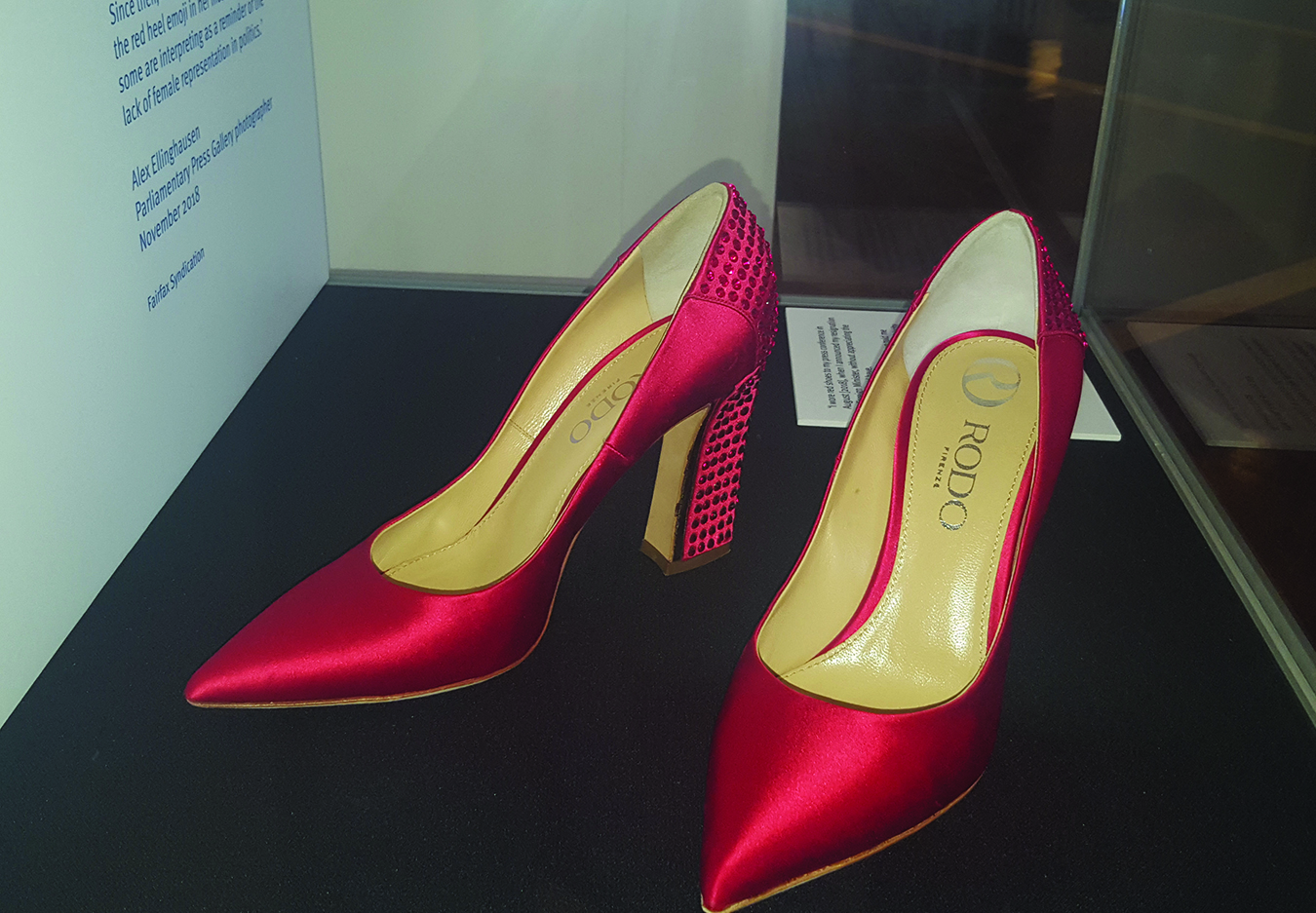
After Scott Morrison won the leadership ballot, the new Coalition team struggled to manage the public’s hostile reactions. Reporters continually speculated on the details of Turnbull’s removal and persistently questioned why Bishop, the most popular Liberal politician and a moderate, had not been supported by her colleagues. On the obvious slight, Bishop was silent, until Julia Banks resigned from the Liberal Party, fuelling a belief that both women had suffered from sexism. Banks and Bishop went public with their assessment of the politics – in their different ways – on the same day.
The chain of events demonstrates that attempting to manage media depends on skill, judgement and an element of luck. The day began with two senior ministers starting a ‘presser’, hoping to switch off negative media coverage of the new government with good news about the economy. During the press conference, they (and those in attendance) were alerted by mobile phone that Julia Banks was beginning a resignation speech in the House of Representatives, citing a sexist party room and culture as major reasons for her departure. Press crews captured the surprise and immediate dispersal that this information occasioned – with some participants televised running back to the House. News images followed of women from the backbenches and the crossbench warmly empathising with Banks and supporting her, confirming the view long held by many that the Liberal Party had a gender problem, even with its successful, experienced female members.
Bishop’s flamboyant shoes at her own ‘presser’ later that day might be read as a light-hearted prop chosen by a senior female politician with an interest in fashion that was familiar to the public. Nothing is so simple. In a disastrous week for the Coalition, the shoes worked as a complicated sign with fluid (not infinite) meanings: Bishop’s implicit support for Banks’ struggles; her silent comment on being marginalised by a sexist Liberal party room; or the West Australian seizing a pertinent moment to remind her constituency that she remained a potential prime ministerial candidate, despite receiving only 11 votes during the Turnbull spill. Bishop’s later tweet about the ‘surprising’ attention the shoes attracted carried a red heels emoji. Bishop is an enthusiastic emoji user with over a quarter of a million followers on Twitter, and an excellent manager of her personal ‘brand’.
Turnbull’s tweet direct to The Australian was also a comment on the spill and on conservative wrath at failing to install a preferred leader. Turnbull used the right of reply on a social media platform against a story attacking his reputation and legacy. Like Bishop, he is not an ordinary citizen. Prior media and public interest in the senders’ political status was required to give both tweets the significance they acquired.
This chapter has touched on mediation processes, old and new players, the challenges of transformation and public concerns. It is encouraging that, despite the loss of trust in contemporary politics, Australians’ interest in political events remains strong. Nielsen digital ratings show that time spent reading online news spiked to 44 per cent more than the daily average on the day of Turnbull’s removal, 24 August 2018, with Australians accessing news across all platforms and devices.[49] In Nielsen’s January 2021 report, 16.5 million Australians were spending nearly two hours per person on current and global news. Research surveys also reveal that Australians generally trust media more overall than other nations like the US or Malaysia.
However, trust in media fluctuates. During the Turnbull spill, Chris Uhlmann’s accusation that some right-wing journalists crossed the line to become ‘players in the game’ in the ousting of a prime minister is a compelling and timely warning against such abuses of the privileges enjoyed by journalists.
During the 2022 election, media coverage from nearly all outlets was attacked. Journalists were seen as political insiders, out of touch with what the public cared about, criticised for setting a trivialising and overly personality-based agendas, and avoiding minor party, independents’ and women’s concerns. A focus on click-worthy content, rather than policy discussion, is a legitimate criticism of mainstream media, along with the increasing and destructive phenomenon of cameras being turned the wrong way, onto journalists themselves. Once journalists’ opinions drive the news coverage, public interest journalism, and thus democracy itself, suffers.
References
Anderson, Benedict (1983). Imagined communities. London: Verso.
Australian Broadcasting Corporation (ABC) (2022). Election ’22. Media Watch [transcript], 23 May. https://www.abc.net.au/mediawatch/episodes/election/13895010
Australian Communications and Media Authority (ACMA) (2018). ‘Media interests’ snapshot. http://www.acma.gov.au/theACMA/media-interests-snapshot
Bartlett, Janie, Josh Smith and Rose Acton (2018). The future of political campaigning. London: Demos. http://www.demos.co.uk/wp-content/uploads/2018/07/The-Future-of-Political-Campaigning.pdf
Centre for Behavioural Economics, Society & Technology (BEST) (2020). Trust and Mistrust in Australian News Media. Brisbane: Queensland University of Technology. https://research.qut.edu.au/best/wp-content/uploads/sites/244/2020/03/Trust-and-Mistrust-in-News-Media.pdf
Cameron, Sarah, and Ian McAllister (2019). The 2019 Australian federal election: results from the Australian Election Study. Canberra: ANU College of Arts & Social Sciences. https://australianelectionstudy.org/wp-content/uploads/The-2019-Australian-Federal-Election-Results-from-the-Australian-Election-Study.pdf
Chain, Brittany (2018). The untold story of ‘Friendlyjordies’: How a male model ditched the catwalk to make a living on YouTube mocking politicians, reality stars and dole bludgers. Daily Mail, 15 November. https://www.dailymail.co.uk/news/article-6391343/From-catwalks-Youtube-content-untold-story-Jordan-Shanks.html
Christensen, Nic (2014). ‘A crazy act of will’: The Guardian Australia turns one. Mumbrella, May 26. https://mumbrella.com.au/bold-adventure-guardian-australia-228790
Couldry, Nick (2008). Mediatization or mediation? Alternative understandings of the emergent space of digital storytelling. New Media and Society 10(3): 373–91. DOI: 10.1177/1461444808089414
De Gregorio, Giovanni (2020). Democratising online content moderation: A constitutional framework. Computer Law & Security Review 36:1-17. DOI: 10.1016/j.clsr.2019.105374.
Digital Content Ratings (2018). Press Room. Nielsen, 6 September. http://www.nielsen.com/au/en/press-room/2018/nielsen-digital-content-ratings-august-2018-tagged-rankings.html
Elton-Pym, James (2018). Turnbull says he is optimistic about Morrison government, slams Dutton in valedictory speech. SBS, 24 August. http://www.sbs.com.au/news/turnbull-s-parting-salvo-at-the-dutton-and-abbott-determined-insurgency
Enhanced Media Metrics Australia (EMMA) (2018). Readership data: September 1–30. http://www.emma.com.au/wp-content/uploads/TRW-Newspapers-Total-Audience-Report-Sep-18.pdf
Federal Parliamentary Press Gallery (n.d.). About us. pressgallery.net.au/about-us/
Fedor, Kelly, and Luke Cooper (2018). Chris Dawson case: ‘pervasive media’ may impact trial, says lawyer. Nine News, 6 December. https://bit.ly/2ldSvu0
Hardaker, David (2022). Journalism is going to have to save itself – because the way it’s going, frankly it’s done for. Crikey, 9 May. https://www.crikey.com.au/2022/05/09/journalism-must-save-itself/
Harris, Lachlan, and Andrew Charlton (2018). The fundamental operating model of Australian democracy is breaking down. Sydney Morning Herald, 2 April. https://bit.ly/2leO8im
Jolly, Rhonda (2017). Media and communications resources and information: a quick guide. Canberra: Parliament of Australia.
Kirkpatrick, R. (2012). Press timeline: 1951–2011. https://www.nla.gov.au/content/press-timeline-1951-2011
Knox, David (2018). Chris Uhlmann accuses News Corp, Sky News, 2GB of ‘waging war’ on Turnbull. Tonight TV, 28 August. https://bit.ly/2kMOk8m
Mazzoleni, Gianpietro, and Winfried Schultz (1999). ‘Mediatization’ of politics: a change for democracy? Political Communication 16(3): 247–61. DOI: 10.1018/105846099198613
Media, Entertainment and Arts Alliance (MEAA) (2021). A thousand journalist jobs gone as COVID bites. https://pressfreedom.org.au/a-thousand-journalist-jobs-gone-as-covid-bites-8383bc26ee4b
Media, Entertainment and Arts Alliance (MEAA) (2018). MEAA journalist code of ethics. http://www.meaa.org/meaa-media/code-of-ethics/
Michael West Media (n.d.). About. https://michaelwest.com.au/about/
New Beats (2018). Redundancy timeline. http://www.newbeatsblog.com/redundancy-timeline/
News Corp Australia (n.d.). Discover new digital solutions to get customers to notice, want and buy your brand. https://www.newscorpaustralia.com/growth-stories/discover-new-digital-solutions-to-get-customers-to-notice-want-and-buy-your-brand/
Nine (2022). The Herald is Australia’s most read masthead as readership continues to increase finds Roy Morgan figures. NineforBrands, 28 February. https://www.nineforbrands.com.au/media-release/the-herald-is-australias-most-read-masthead-as-readership-continues-to-increase-finds-roy-morgan-figures/
Park, Sora, Caroline Fisher, Glen Fuller and Jee Young Lee (2018). Digital news report: Australia 2018. Canberra: News and Media Research Centre. DOI: 10.4225/50/5b21a3c6f196a
Parliament of Australia (2008). Guidelines for filming and photography and general media rules in Parliament House and its precincts, December 2008. Canberra: Parliament of Australia.
Rebel News Network Ltd. (2022). About Rebel News. https://www.rebelnews.com/about
Roy Morgan (2022). Total News readership continues to grow – up 0.9 per cent for the 12 months to March 2022. Finding No. 8988, 23 May. https://www.roymorgan.com/findings/8988-thinknewsbrands-roy-morgan-readership-march-2022-202205221521
Roy Morgan (2018). It’s official. Newspaper masthead readership is up 3.2% to over 16 million! https://bit.ly/2kI4eRg
Rudd, Kevin (2018). Cancer eating the heart of democracy. Sydney Morning Herald, 24 August. https://bit.ly/2wpGKSN
SBS (2019). Our story. https://www.sbs.com.au/aboutus/our-story
Strömbäck, Jesper (2008). Four phases of mediatization: an analysis of the mediatization of politics. International Journal of Press/Politics 13(3): 228–46. DOI: 10.1177/1940161208319097
Tanuki, Tom (2022). Avi Yemini’s case against PRGuy reeks of opportunism. Independent Australia, 18 June. https://independentaustralia.net/politics/politics-display/avi-yeminis-case-against-prguy-reeks-of-opportunism-,16477
Tien, Shannon (2018). How the Facebook algorithm works and how to make it work for you. Hootsuite, 25 April. https://blog.hootsuite.com/facebook-algorithm
Turnbull, Malcolm [@TurnbullMalcolm] (2018). Attribution bias – blaming others for the consequences of your own actions is a common symptom of paranoia. Imagining “invisible” people are out to get you is also a classic symptom…[Tweet]. Twitter, 29 November. https://bit.ly/2mMJTuZ
About the author
Dr Mary Griffiths is an adjunct associate professor in the Department of Media at the University of Adelaide, where she taught courses in media, democracy and e-participation, while developing media and political internships and sector engagement. Her published research includes work on citizen–government relations, the role of the democratic press and smart governance. She is a co-editor of a collection of studies on digital disruption, Making publics, making places (2016), and an associate editor of the Electronic Journal of E-Government.
- Revised by the author in 2023. Griffiths, Mary (2024). Media and democracy. In Nick Barry, Peter Chen, Yvonne Haigh, Sara C. Motta and Diana Perche, eds. Australian politics and policy: 2024. Sydney: Sydney University Press. DOI: 10.30722/sup.9781743329542. ↵
- Mazzoleni and Schulz 1999. ↵
- Strömbäck 2008. ↵
- Couldry 2008, 374. ↵
- Anderson 1983, 6. ↵
- Kirkpatrick 2012. ↵
- Roy Morgan 2018. ↵
- COVID-19 accelerated the trend, with the peak journalists’ body putting the job losses over 2020 at over 1,000, mostly from rural and regional areas: MEAA 2021. ↵
- News Corp Australia (n.d.). ↵
- Cameron and McAllister 2019. ↵
- Harris and Charlton 2018. ↵
- The first print ‘news’ pamphlet in Australia was partisan: it was established by the NSW government for a settler colony. ↵
- BEST Centre 2020. ↵
- Knox 2018. Chris Uhlmann launched a passionate attack on the Liberal–National Coalition leadership plotters, and included News Corp, Sky News, and 2GB staff, arguing that the latter were no longer observers but ‘players’. ↵
- Christensen 2014. In an interview with Mumbrella, Guardian Australia’s editor, Katherine Murphy, commented on rival NewsCorp’s approaches to public debate. ↵
- Elton-Pym 2018. ↵
- Kevin Rudd has continued forthright attacks on NewsCorp (Rudd 2018). ↵
- ABC 2022. ↵
- See ‘Media inquiries’ below for further discussion. ↵
- Michael West Media (n.d.) ↵
- See Turnbull 2018. ↵
- https://www.trackalytics.com/youtube/user/friendlyjordies/ ↵
- Chain 2018. ↵
- Park et al. 2018. ↵
- Tien 2018. ↵
- Bartlett, Smith and Acton 2018, 10. ↵
- In the wake of media reports, Instagram has responded to UK activists by promising to redesign the automated forwarding of self-harm content to already vulnerable people. See De Gregorio (2020). ↵
- Instagram has responded to UK activists, after media reports, by promising to redesign the automated forwarding of self-harm content to already vulnerable people. ↵
- ACMA 2018. ↵
- Roy Morgan, 2022. ↵
- EMMA 2018. ↵
- Nine 2022. ↵
- First broadcast on November 12, 2018. ↵
- Australian Broadcasting Corporation Act 1983 (Cth). ↵
- SBS 2019. ↵
- Succeeded in 2022 by the first Indigenous woman to hold the office, Linda Burney. ↵
- The other three ‘estates’ describe the checks and balances appropriate for democratic governance. In secular Australian governance, the three powers are the executive, the administration, and the judiciary. ↵
- New Beats 2018. ↵
- Fedor and Cooper 2018. ↵
- The Museum of Australian Democracy’s annual exhibition is online at https://bit.ly/2lfzV4B ↵
- An ABC report on the High Court decision summarises the case: https://ab.co/31Vv8FT ↵
- ACMA 2018. ↵
- Jolly 2017. ↵
- MEAA 2018. ↵
- See ‘Co-location,’ below, for an example of a failed attempt. ↵
- Parliament of Australia 2008. ↵
- Federal Parliamentary Press Gallery n.d. ↵
- Hardaker 2022. ↵
- Digital Content Ratings 2018. ↵