23 Indigenous politics
Diana Perche and Jason O’Neil
Key terms/names
constitutional recognition, Country, First Nations, First Peoples, Indigenous, invasion, the Intervention, self-determination, settler colonialism, sovereignty, treaty/‘Makarrata’ (Yolŋu word)
Indigenous politics is possibly one of the most complex and misunderstood areas of politics in Australia.[1] Indigenous issues are often presented as particularly contentious, and the divergence of interests between governments, business, the community and First Peoples themselves is frequently emphasised. We know that Indigenous issues do not have much salience in public opinion polls.[2] Nevertheless, political leaders at both state and federal levels have often sought to use Indigenous issues to score points in public debates, demonstrating their ideological credentials. Many debates in Indigenous affairs are framed around deep-seated conflicts over values such as choice, equality, rights, responsibility, diversity, self-determination and sovereignty.
The major parties have moved away from the bipartisanship that surrounded the 1967 constitutional referendum and the passage of the Aboriginal Land Rights (Northern Territory) Act 1976 (Cth). Instead, over the past three decades, we have seen divisive and confusing debates around the Mabo case and the recognition of native title;[3] the creation and abolition of the Aboriginal and Torres Strait Islander Commission (ATSIC); the move towards ‘mainstreaming’ of Indigenous government services after decades of self-determination; the acknowledgement of the Stolen Generations culminating in the apology given by Prime Minister Kevin Rudd in 2008; the Northern Territory Emergency Response (the Intervention), affecting residents of remote communities, introduced by the federal government under Liberal–National Coalition (Coalition) Prime Minister John Howard in 2007; and the current debate around constitutional recognition, treaty and a ‘Voice’ to parliament.
It is difficult for a relatively small minority to gain a genuine voice for their issues in the mainstream media and government. It is also challenging to develop effective policies without an understanding of First Nations culture and communities. This chapter breaks down some of these difficulties by:
- exploring the identities of First Peoples and how they understand their place within Australia
- considering the structural barriers to political participation by First Peoples
- briefly explaining the history of activism by First Peoples since colonisation.
We conclude by reflecting on whether there is one ‘Aboriginal movement’ or many, and considering the significance of the Uluru Statement from the Heart and the return to nation-based identities.
Who are the First Peoples in Australia?
It is useful to clarify the terminology that is used in this chapter. First Peoples in Australia have been called many things by non-Indigenous people since the 18th century. Some of these are now recognised as outdated, being based in theories of racial difference. Even the terms ‘Aboriginal’ and ‘Torres Strait Islander’ describe legally defined identities that have been imposed. Prior to the arrival of Europeans, there were no ‘Aboriginal’ people in Australia – there were Dharug, Wiradjuri, Larrakia, Noongar, Ngarrindjeri and so on, and these identities remain important today. The authors of this chapter have elected to use the collective terms ‘First Peoples’ and ‘First Nations’, in recognition of this history and the diversity of First Peoples. The two terms are used interchangeably, depending on whether the emphasis is on Indigenous Australians as collective peoples or as collective polities.
Legal definitions of identity are often debated, and sometimes disparaged, and it is important to understand the ways in which identity can be externally imposed or denied. In public policy, the ‘Commonwealth definition’ adopted by the government in the late 1970s remains current for the purposes of determining eligibility for Indigenous-specific programs and employment in identified positions. It determines Indigenous status based on three criteria:
- that the person is of Aboriginal (or Torres Strait Islander) descent
- that they identify as Aboriginal or Torres Strait Islander
- that they are accepted as such by the community in which they live.[4]
These criteria have been difficult for some people to satisfy, particularly members of the Stolen Generations who have lost links to their birth families and their communities. For many First Peoples living in cities or country towns throughout most of the 20th century, it was preferable to deny Aboriginal heritage or avoid connecting with other Aboriginal people, out of fear of racism and social exclusion.[5]
The principle of self-identification is recognised in the United Nations Declaration on the Rights of Indigenous Peoples, which states: ‘Indigenous peoples have the right to determine their own identity or membership in accordance with their customs and traditions’.[6] The damage done to First Nations through colonisation, with the associated loss of land, culture, language and connection to kin, has made this very difficult for many First Peoples, even today. This is sometimes reflected in present-day conflicts over native title, recognition of traditional ownership and governance of organisations and communities.
The importance of self-identification is clear when we consider the Commonwealth’s official statistics on the size of the First Nations population in Australia. The 2016 Census counted 649,171 Aboriginal and Torres Strait Islanders – 2.8 per cent of Australia’s population.[7] While First Peoples make up over 25 per cent of the population of the Northern Territory (NT) (over 58,248), the largest numerical population lives in the states of New South Wales (NSW) (216,176) and Queensland (186,482). Aboriginal and Torres Strait Islander people are more likely than non-Indigenous people to live in remote or very remote parts of Australia; nevertheless, over one-third of the Indigenous population lives in capital cities.
There are hundreds of different First Nations in Australia, with different cultures, traditions, lore and languages. First Peoples believe they were born out of ‘Country’. Country represents a specific area of land and water, but is not reducible to just the geography of the land and its flora and fauna. Each Nation belongs to and is a part of Country, which they are responsible for, born from and live with in a mutually beneficial relationship. All elements of a First People’s Country connected not only with each other but also with other Peoples’ Country. In English, Country is an expression of First Peoples’ understanding of the cosmos or ‘philosophy of existence’.[8]
While their cultures and languages differ widely, all First Peoples have a spiritual connection to Country, to the land of their ancestors and its inhabitants. This is because First Peoples believe that land, people and the laws that govern them all were created at the same time by their ancestral creation beings. There is an inherent understanding that all things are connected: First Peoples are connected to Country through their ancestors, who were born from Country. These connections are expressed here by Yolŋu elders:
Bawaka is our homeland, our Country. Country means the land, but it means so much more too … When ngapaki [non-Indigenous people] come to Bawaka, we ask Bawaka Country to welcome you. Bawaka is alive, it talks to us and cares for us … We welcome you so that the land and the sea, the tides, the currents, the plants, the animals, the winds, the rocks, the songs and the dreams recognise you.
And we are Bawaka Country too, Yolŋu people, our ancestors and our unborn children, with our Yolŋu languages (dhäruk), our Yolŋu knowledge and our Yolŋu Law (Rom). People are Country too … Country will welcome you as long as you respect it, as long as you behave well and care for the land and the nature, care for each other as family, as kin.
Country is everything in balance, everything connected as kin. Country nourishes us, and we nourish Country. We can’t be separated from it … We live on Country, we won’t be treated as if we have no strength, no knowledge, no Law, no language. Country makes us strong. Country cares, Country nourishes, Country is who we are. We are Yolŋu.[9]
This connection, and the wealth of Indigenous knowledges and science that come with it, have largely been overlooked by governments throughout settler-colonial history. Since the earliest days of colonisation, land has been seen as a commodity to be exploited. This is the antithesis of First Peoples’ connection to Country – a living entity that is to be cared for and cultivated only in accordance with its needs and limitations.
An important aspect of the relationship between First Peoples and Country is the cultural protocol of not speaking for someone else’s Country. First Peoples are quick to reject anyone who purports to speak on their behalf. In its simplest form, this is a recognition of each People’s custodianship over their own Country. In a political context, every Nation has its own issues, priorities and internal politics; local decision making involves a long process of consensus building to ensure that the right decision is made and that it is done in a culturally appropriate way. At an individual level, it is important that everybody’s voice is heard. Indigenous governance is built on consensus-making: sitting down and talking through an issue until there is a solution that everyone can accept. When this diversity of views is left unrecognised, it can lead to issues of misrepresentation and inappropriate decision making. This is often the case when governments fail to tailor their policies to local needs or when one individual is called on to speak on behalf of all First Peoples.
Political activism and engagement
The arrival of European settlers in Sydney Cove in 1788 was not a peaceful process. When understood from the standpoint of the clans of the Eora Nation, the first to encounter the settlers as they established the British penal colony, it was the beginning of an invasion. Despite being weakened by disease and malnutrition, as their food sources were destroyed or made inaccessible, the First Peoples were not passive, and violence spread as the settlers sought to extend their control over the Country of neighbouring Nations. Violent battles, revenge attacks and reprisals were common in the early years of the colony, and losses in what we now know as the ‘Frontier Wars’ were severe.
By the 1830s, colonial governments had begun to move Aboriginal people away from settlements, onto reserves and missions, under supervision, and eventually established the regime of ‘protection’, under which Aboriginal people were segregated, prevented from moving freely and subjected to ‘civilising and Christianising’ by missionaries and superintendents. Children with lighter skin or mixed parentage were removed. First Peoples had their freedom of movement and freedom of association constrained under the supervision of the Protection Boards. All of these actions combined are now understood to be acts of genocide, seeking to ‘eliminate the native’.[10] First Peoples continued to resist the power of the settlers through this period with overt political tactics, such as petitions, rebellions and formal complaints to authorities about their treatment and conditions, often demanding the right to own land, and through less visible actions, including maintaining culture and language in secret.
By the end of the First World War, many reserves were closing in the south, as land was reallocated to soldier settlement schemes and governments found the costs of maintaining reserves and providing rations and housing increasingly prohibitive. Many First Peoples were forced to live on the fringes of urban settlements, relying on precarious low-paid employment. In the north, where frontier conflicts continued into the 1920s, large reserves were still being used to restrict the movements of First Peoples, and to suppress culture and language in coercive and punitive environments, especially in Queensland. The impact of this violence, racism and exclusion continues to affect many First Peoples today, in the form of intergenerational trauma.
First Nations political activity was very much constrained by government, but this does not mean that it was non-existent. On missions and reserves, resistance took many forms, such as women’s ongoing efforts to preserve culture and kinship ties against the wishes of the authorities.[11] Early political organisations, such as the Australian Aboriginal Progressive Association, founded by Fred Maynard and Tom Lacey, and later the Australian Aborigines’ League under the leadership of William Cooper, Doug Nicholls and Margaret Tucker, called for land and citizenship rights in the 1920s and 1930s. A significant protest was organised in Sydney on 26 January 1938, known as the ‘Day of Mourning’, disrupting celebrations of the 150th anniversary of British settlement in Australia and prompting Prime Minister Joseph Lyons to meet with a delegation of men and women to discuss their concerns. These organisations received support from non-Indigenous activists, including Christian groups, trade unionists and members of the Communist Party of Australia.
By the 1960s, activism around Indigenous issues had become much more visible, and First Nations voices were increasingly being reported by the media. The government’s policies of segregation and ‘protection’ were abandoned in favour of ‘assimilation’. Governments began to extend essential services and entitlements to Aboriginal people, including access to education and health care and eligibility for welfare payments.[12] In return, First Peoples were expected to abandon their culture and ‘learn’ to live their lives as white Australians did. These assimilationist policies allowed greater freedom of movement and access to education and employment for First Peoples, but their lack of equal treatment as Australian citizens became increasingly obvious to the wider public. The Australian government faced international criticism over the poverty and exclusion of First Peoples.[13] Meanwhile, the civil rights movement – a coalition of activists including feminists, Christians and trade unionists – focused on the campaign to give Aboriginal people ‘citizenship’ by amending the Constitution.[14] In reality, the 1967 referendum was more limited in its impact: it removed the provision in the Constitution that excluded Aboriginal people from being counted in the Census and gave the Commonwealth the power to legislate on issues affecting Aboriginal people, a measure that activists hoped would override the obvious neglect of First Peoples’ welfare by state and territory governments.[15]
The apparent achievement of formal political equality for First Peoples as a result of the civil rights movement in the 1960s satisfied many white activists, but it was soon clear that little would change the substantive inequality experienced by First Peoples, particularly economic inequality and poverty.[16] Land rights were the subject of much of the political activism during this period, both in terms of the rights of First Nations to make decisions about what happens on their traditional lands and in terms of the potential for land ownership rights to be the basis of economic development – a path out of poverty. The spiritual significance of Country and its importance as the basis of law and social and cultural wellbeing was also emphasised by First Peoples. A number of key flashpoints attracted attention in metropolitan areas, such as the Yolŋu protests over bauxite mining at Yirrkala and the Gurindji walk-off at Wave Hill, where aggrieved station hands demanded the restoration of their land.[17]
Land rights were also a significant part of the demands made by protesters at the Aboriginal Tent Embassy, established in January 1972 on the lawns in front of Parliament House in Canberra. For the Commonwealth, the struggle for land rights was ultimately an issue that could not be ignored, and the Labor Party, under the leadership of Gough Whitlam, worked on developing a policy to legislate for land rights in the NT. This legislation was ultimately passed by Malcolm Fraser’s Liberal government in 1976. Many vested interests, such as mining companies and pastoralists, fiercely opposed the land rights legislation. They were supported by the NT government in resisting claims. First Nations activists were obliged to contest claims and defend hard-won rights for many years. As Arrente activist and former Director of the Central Land Council Bruce (‘Tracker’) Tilmouth observed, ‘land rights took a lot of getting, by a lot of people’.[18]
First Nations have continued to force issues onto the government’s agenda through protest, advocacy and sustained campaigns. In many areas, activists have worked for long periods of time to achieve recognition for significant issues, struggling to gain acceptance of the problems in the face of government and media indifference or active resistance from vested interests. For example, Meriam man Eddie Koiki Mabo and others pursued their claim for recognition of ownership over land in the Torres Strait in a series of court cases against the Queensland government, which lasted for over a decade, and eventually resulted in the significant Mabo case decided by the High Court in 1992 and the subsequent passing of the Native Title Act 1993 (Cth) by the Keating Labor government.
In several cases, the Commonwealth government has been obliged to respond to First Nations advocacy by establishing wide-reaching inquiries. These have substantially changed the debate around Indigenous affairs over time. Notable inquiries include the Royal Commission into Aboriginal Deaths in Custody (1991) and the inquiry into the Stolen Generations (1997). Both allowed First Peoples to be heard and reported. Both challenged accepted narratives of Australia, pointing to the racism embedded in institutions, policy decisions and society. More recently, the Royal Commission into the Detention and Protection of Children in the Northern Territory (2017) has shown that institutionalised racism has not diminished in many parts of the Australian political system.[19]
Indigenous organisations and leadership
The 1960s and 1970s saw First Peoples push for self-determination, in recognition of their unique status as Indigenous peoples and in pursuit of their own solutions to disadvantage and dispossession. With cautious support from the Whitlam Labor government, First Nations people put self-determination into practice by establishing Indigenous organisations such as land councils, community-controlled health services, charities and social enterprises. First Peoples needed legal entities to hold the title for land rights and to negotiate with mining interests. Organisations like the Aboriginal Legal Service and Aboriginal Medical Service were started by First Peoples to meet their communities’ legal and medical needs. These organisations seek to maintain independence from the government of the day, but many rely on government funding to operate. Indigenous organisations are now widespread, delivering services to local communities, employing substantial numbers of First Peoples and acting as representative bodies.
Successful Indigenous organisations and businesses have empowered First Peoples to attain new levels of wealth and success within Australia’s political and economic system. Individuals who achieve this success are often identified as Aboriginal or Indigenous ‘leaders’ by governments and the mainstream media. This can lead to controversy because First Peoples identify very strongly with their Elders. Elders are the leaders of Indigenous families and communities. People do not become Elders simply by virtue of age. Although they may garner respect due to seniority, they will not be recognised by the wider community without a level of cultural knowledge and leadership.[20] It is this cultural knowledge that is the source of authority within First Nations. Elders are respected as knowledge holders – the custodians of knowledge passed down to them by their own Elders about the proper way to do things according to obligations to Country and lore.
Leadership is a contentious issue in Indigenous politics.[21] It cannot be assumed that a democratically elected leader holds legitimate authority in an Indigenous context. This is one reason why ATSIC was subject to criticism by First Peoples: the commissioners were elected in a democratic process but were not seen as legitimate representatives of the regions and peoples they served.[22] When governance is structured to meet the needs of the settler-colonial state, it is easily critiqued as denying First Nations sovereignty, and the cultural authority held by Elders and Traditional Owners over their Country. Media and government departments need to be mindful of singling out Indigenous individuals because of their success or qualifications within the Australian system, as they may lack cultural authority within the community. This is important because governments have a reputation of woefully inadequate consultation with First Nations. Finding the right people to talk to – those who have the authority and knowledge relevant to the issue – can be a difficult task. This is the heart of the problem of treating First Nations as a broad Aboriginal or Indigenous population, rather than as a diverse collection of communities with identities independent of each other and of the broader Australian population.
Case example: Seed Indigenous Youth Climate Network and climate justice
The relationship between First Peoples and Country means that environmental issues are understood as essential to protecting Country, culture and First Nations livelihoods. Despite this, the voices of First Nations people are often absent in debates on environmental issues. Seed Indigenous Youth Climate Network (Seed) is an organisation founded in 2014 by First Nations young people that works to empower First Nations communities and individuals to campaign against fossil fuel extraction on their Country and for climate justice. Seed is concerned with climate ‘justice’ because climate change disproportionally affects those who have contributed the least to carbon emissions, including young First Nations people.[23]
Seed has been involved in two major campaigns. They have supported First Nations communities in the NT to learn about the impacts of hydraulic fracturing (fracking) and to campaign against fracking being allowed on their Country. Seed has also collaborated with other organisations in the Stop Adani movement, opposing the Carmichael coal mine being built on Wangan and Jagalingou Country.
The model of activism used by Seed involves community-based education of First Nations peoples on the potential impacts of fossil fuels on Country; training First Nations young people to be grassroots campaigners and elevate the voice of First Peoples; collaborating with other environmental organisations to raise awareness of their own campaigns; and aspiring to make climate change an Indigenous issue.
The work of Seed and young First Peoples campaigning for climate justice is giving a voice to communities that are both the most invested in the wellbeing of Country and the first to feel the impacts of climate change.
Barriers to engagement and participation
Like other minorities, First Peoples face considerable structural barriers to full participation in the Australian political system. It is important to recognise that, in the case of the First Nations, these structures have been firmly entrenched since the earliest days of European colonisation. Settler law and institutions took no account of the existence of First Peoples, deliberately ignored their ownership of the land and denied their sovereignty. In this section, we will briefly consider some of the factors that continue to prevent Aboriginal and Torres Strait Islander peoples from enjoying political equality. These include obstacles to political representation, institutional impediments to accountability and the role of the media.
The Australian Constitution explicitly excluded Aboriginal people from the newly formed political community, and First Peoples were not included in the constitutional conventions leading to Federation. Aboriginal people were not given the right to vote in federal elections until 1962; even after that date, voting was not compulsory for Aboriginal people. The franchise for Aboriginal citizens had been inconsistently applied and even occasionally withdrawn by state governments throughout the first half of the 20th century. Under pressure from the Commonwealth, all state jurisdictions legislated the right to vote and to stand for election for First Peoples during the 1960s, with Queensland the last to conform in 1965.[24] In some jurisdictions, little effort was made to encourage enrolment until compulsory voting was finally extended to Indigenous people in 1984.[25]
Even after gaining the vote, it proved extremely difficult for First Peoples to gain representation in parliaments. The relatively small First Nations population is scattered across many electorates. The majoritarian electoral system guarantees that a substantial number of electorates are ‘safe seats’, where a large majority of voters favour one or the other major party and minority voices are easily overlooked. Furthermore, the dominance of the major parties means that candidates most often rely on party support to get elected, and Indigenous people have, until recently, only very rarely been preselected by major parties to run for election, especially for winnable seats. The first Indigenous member of the federal parliament was Neville Bonner, Liberal senator for Queensland, who served from 1971 to 1983. Aden Ridgeway was the second, elected in 1998 as senator for NSW, representing the Australian Democrats, and serving one term. The first Indigenous member of the House of Representatives was not elected until 2010, when Liberal candidate Ken Wyatt, a Noongar man, became the member for the Western Australian (WA) seat of Hasluck. The number of Indigenous members of parliament at the state and territory levels remains very small, with the exception of the NT.[26]
The lack of parliamentary representation for First Nations has received critical attention in recent years, and political parties have much work to do in ensuring that First Peoples are preselected as candidates. The 2016 federal election was notable because a record number of 17 Indigenous candidates stood for election across the nation, of which 11 were preselected by either Labor or the Coalition.[27] The 2019 federal election saw 22 First Nations candidates campaigning, though only eight of these were running for major parties, and few in winnable seats.[28] Following the 2016 election, albeit briefly, the number of Indigenous members of parliament rose to a peak of five, including Ken Wyatt (Liberal, Hasluck) and Linda Burney (Labor, Barton) in the House of Representatives, and Patrick Dodson (Labor, WA), Malarndirri McCarthy (Labor, NT) and Jacqui Lambie (Jacqui Lambie Network, Tasmania) in the Senate.
Once elected, the challenges of working effectively in a white institution can be enormous. The adversarial debating system, the majoritarian electoral system, which allows little room for consensus building, and the dominance of the two major parties, which frames issues as binary decisions, all work against the First Peoples’ traditional forms of decision making. Maddison observes the ‘representational dilemmas’ experienced by First Nations members of parliament, as elected representatives are constrained by party discipline and are not free to speak against the party line, even on issues that may negatively affect First Peoples.[29] Nor can they easily represent the diverse interests of all First Peoples, including those outside their own electorates. The need to manage expectations in the electorate is often challenging.
Despite these constraints, the presence of First Nations members of parliament is significant. They reflect the presence of First Nations people in the wider community and give the otherwise white institution greater legitimacy. First Nations members of parliament take opportunities to present different perspectives in debates and committee inquiries. This has proven particularly important in the Senate estimates committee process, where Labor Senators McCarthy and Dodson have used their practical understanding of the impact of government policy in remote parts of Australia to interrogate ministers and bureaucrats working in Indigenous affairs and to hold the government more effectively to account for the impact of its policies in Indigenous communities. Finally, there is undoubtedly strength in numbers, and solidarity can stretch across the parliamentary chamber, as the member for Barton, Linda Burney, noted in 2018:
The wonderful thing is that we [the Labor Party] have a First Nations caucus, and we have a very good relationship amongst the Indigenous MPs, no matter what part of Parliament we’re on. We have a good relationship collectively, and we meet informally. That’s the mechanics, and the framework we’re working in.[30]
Parliamentary representation is not enough on its own to ensure that governments are held to account for decisions affecting First Peoples. Indeed, detrimental policies are frequently made by governments driven by ideological agendas or bureaucratic misunderstanding of the issues. The Commonwealth government’s winding back of native title law and the abolition of ATSIC under Prime Minister John Howard are notable examples, as are the Labor government’s decisions under Prime Ministers Julia Gillard and Kevin Rudd to dismantle the successful Community Development Employment Program and refuse to consider compensation for members of the Stolen Generations following the apology in 2008. In each case, government policy reflected dominant settler ideological views about the inappropriateness of ‘separate’ or ‘different’ treatment of First Peoples compared to the non-Indigenous population, and dismissed calls for redress or recognition of the special status of First Nations as sovereign peoples with specific rights. A more recent example is the Community Development Program introduced by the Abbott Coalition government, a punitive form of ‘Work for the Dole’ targeting people living in remote parts of Australia, with poorly designed ‘work-related activities’ alongside severe penalties for failing to attend the activities five days a week, all year round.
In the most striking example, the Howard government’s decision to impose an intervention on remote communities in the NT was rushed through parliament in 2007, with no opportunity to consider the perspectives of First Nations and those affected, in a crisis-driven response to the problem of child sexual abuse in some remote Indigenous communities. The extreme and widely criticised response included compulsory welfare quarantining, enforced health checks and school attendance for children, alcohol bans, increased police presence, changes to housing tenure, abolition of the permit system controlling access to Aboriginal-owned land and compulsory acquisition of leases over townships on Aboriginal land. The initial rollout of the Intervention included army and police officers and the installation of a ‘Government Business Manager’ in each community.
The targeted nature of these measures required the government to suspend the Racial Discrimination Act 1975 (Cth), underlining the illegitimate nature of the Intervention. For some observers, the Howard government appeared opportunistic, using the cover of a ‘crisis’ in remote communities to justify the rapid implementation of unpopular and far-reaching changes that it had wanted to introduce, in particular the imposition of township leases and the removal of permits controlling access to Aboriginal land.[31] Others noted the lack of evidence base for the policy measures[32] and the absence of logical connections between the imposed policies and the problem of child abuse that had been identified in the original report that triggered the crisis – the Ampe akelyernemane meke mekarle (‘Little children are sacred’) report.[33] The Howard government lost the election immediately after rolling out the Intervention in the prescribed communities, but the incoming Rudd government chose to extend it by another five years and expand its reach to more communities, despite criticism and clear opposition from many of the First Peoples affected.[34]
Sullivan explains that this lack of accountability is because the intended audience is not the First Peoples, but rather:
The wishes of white Australia, the context in which those wishes are formed largely through mass media images and reporting, and the ability of government to convince white Australia of adequate funding, appropriate programs and commensurate performance are significantly more influential than the voices of Aboriginal citizens. One of the greatest inhibitors of Aboriginal development is that Aboriginal policy is formulated for the non-Aboriginal public.[35]
Yolŋu Elder and leader Galarrwuy Yunupingu has observed the same phenomenon over decades of pursuing legislative and policy reform for his people, engaging with both Labor and Liberal governments. He points to the deeper settler logic that prevents genuine responses to First Nations demands for change:
All the prime ministers I have known have been friendly to me, but I mark them all hard. None of them has done what I asked, or delivered what they promised … For a prime minister is beholden to his party and to the parliament, which in turn is held by the Australian people. And the Australian people seem to disapprove of my simple truths, or the idea of proper reconciliation. The Australian people do not wish to recognise me for who I am – with all that this brings – and it is the Australian people whom the politicians fear. The Australian people know that their success is built on the taking of the land, in making the country their own, which they did at the expense of so many languages and ceremonies and songlines – and people – now destroyed.[36]
The challenge of holding governments to account for policies targeting First Peoples is even more complex given the overlapping responsibilities of the Commonwealth and state and territory governments and the opaque nature of federal–state financial arrangements, which see Commonwealth funds disbursed to states and territories to spend on disadvantaged populations, without any clear lines of accountability.[37] The perennial issue of overcrowded housing on Aboriginal-owned land in the NT is a clear example of the blame-shifting that can occur as funds are allocated by one level of government and spent by another, with poor outcomes. Similarly, the Commonwealth’s ‘Closing the Gap’ policy, designed to close gaps in health, employment, education and other outcomes between Indigenous and non-Indigenous people, has failed to meet many of the targets originally set in 2008, but responsibility for the failure is difficult to trace due to the multiple departments and agencies involved, across two levels of government.
The attention paid by mainstream media to Indigenous affairs is minimal, as a rule, with occasional bursts of intense, almost voyeuristic scrutiny.[38] This is, in part, because assumptions are made in newsrooms that stories about Indigenous affairs are not of interest to urban audiences on the east coast.[39] Few media outlets employ journalists who specialise in Indigenous affairs. Furthermore, journalists’ understanding of the lives and circumstances of those living in remote Indigenous communities is usually extremely limited, given the lack of ongoing contact and time spent in the communities, along with language and cultural barriers.[40] Often this will mean that the government’s framing of an issue can go unquestioned, and few Indigenous voices are directly reported.
This distance between mainstream media and First Peoples has consequences in terms of the wider public’s understanding of the issues. Sensationalist coverage focusing on dysfunction, alcohol consumption, violence, welfare dependence and poverty is often dominant and entrenches racist stereotypes without providing an understanding of the context.[41] This creates an environment in which extreme and paternalist policies can be imposed with little backlash from voters. Researchers Kerry McCallum and Holly Reid have observed the particular influence of The Australian newspaper. As one of the few mainstream media outlets choosing to focus on Indigenous issues, the newspaper uses a ‘campaigning’ approach, framing stories about Indigenous communities in ways that emphasise individual responsibility, moral failure and crisis, thereby endorsing government action such as the Intervention. The newspaper also privileges the voices of a small number of conservative Indigenous leaders.
First Peoples are increasingly using special interest media and social media to expand the range of voices in public debate. Indigenous newspapers, such as the National Indigenous Times and the Koori Mail, community radio stations and the government-funded National Indigenous TV (NITV) are presenting First Nations perspectives and voices and covering stories not receiving attention elsewhere. The @IndigenousX rotating Twitter account and blog also makes a significant contribution to social and political debates, creating awareness of Indigenous knowledge and perspectives and providing an independent communication channel for a diverse range of views. First Nations journalists are also increasingly taking up positions in mainstream newsrooms and studios, articulating viewpoints that rarely receive public attention.[42]
One movement or many?
Demands from First Peoples for change have taken many different shapes throughout Australia’s political history. The 1970s saw the birth of a strong pan-Aboriginal movement,[43] inspired by the civil rights and Black Power movements in the USA. First Peoples collaborated as a nationwide collective to campaign for land rights, self-determination, treaty and sovereignty. This movement instilled a strong Aboriginal identity in many First Peoples. Following the Howard government’s dismantling of ATSIC and rejection of self-determination in favour of ‘practical reconciliation’, there has been a strong emphasis on engaging with Aboriginal and Torres Strait Islander individuals through increasingly neoliberal policies. At the same time, in opposition to the one-size-fits-all approach of government and in a resurgence of First Nations identities and political culture, the emphasis has shifted from the pan-Aboriginal movement of the 1970s back to a focus on localised Nation-based identities, recognising the sovereignty of each Nation over their own Country.
First Nations sovereignty remains the great unanswered question of Australia’s colonisation.[44] First Peoples claim sovereignty as distinct political communities, while also pursuing their rights as citizens of Australia. This can be a source of conflict and confusion in Indigenous politics.[45] First Nations have continuing sovereignty over their Country, which exists alongside and arguably in contestation with the sovereignty of the Crown. The High Court of Australia has refused to consider First Nations as sovereign;[46] to do so would be to challenge the sovereignty from which the High Court receives its authority.
Sovereignty is often understood in international politics as the power to exercise supreme and unrivalled authority within a given territory. As Falk and Martin explain, most First Nations’ demands for recognition of sovereignty do not take this form. Rather, they rely on a notion of ‘internal sovereignty’, which is shared, recognised and negotiated within a geographic area.[47] This is concerned with creating the space for First Nations communities to protect their culture, law and traditions and to exercise autonomy with respect to matters that are important to them, such as economic development, land resource management, protection of cultural heritage and education.[48] Internal sovereignty does not seek to displace non-Indigenous people but does demand recognition of the identity and authority of First Nations to make decisions for their own people. First Nations hold sovereignty not as Aboriginal and Torres Strait Islander individuals, nor as a single pan-Aboriginal movement, but as hundreds of distinct polities across the continent. For this sovereignty to be exercised, it needs to be recognised at the local and regional level, acknowledging the authority of the respective Nations.
The return to Nation-based identities has also seen a reinvigoration of the treaty movement. Some of Australia’s state governments have recognised this reality and begun negotiating with First Nations on a government-to-government basis.
While there is a clear need to redefine the relationship between First Nations and government, the path forward is unclear. There have been calls for self-determination and treaty for at least 50 years. First Nations and individuals have their own articulations of what sovereignty looks like, what constitutes real ‘self-determination’ and the contents and parties to any treaty or treaties.[49] The following case examples examine two prominent models: state-based treaty-making and a federal constitutionally enshrined ‘Voice’. Both models are valuable examples of how the settler-colonial state can renegotiate its relationship with First Nations within the framework of a liberal federalist representative democracy.
Case example: Victorian treaty process
The Victorian Labor government led by Premier Daniel Andrews committed to treaty negotiations in February 2016 and has engaged in a process of consultations with First Peoples in Victoria through Self-Determination Forums, Aboriginal Victoria Forums, a Community Assembly and the establishment of the Victorian Treaty Advancement Commission. Jill Gallagher AO, a Gunditjmara woman, was appointed as Treaty Advancement Commissioner. Her work involves advancing the treaty process and establishing an Aboriginal representative body. In February 2019, the representative body was named the First Peoples’ Assembly of Victoria. The role of the assembly is to establish the negotiation framework for treaty, including ‘what is on and off the negotiating table, and who can negotiate’.[50]
The First Peoples’ Assembly will be made up of 28 Traditional Owners. Eleven seats are reserved for the 11 recognised Traditional Owner groups. The other 17 will be democratically elected by all Victorian First Peoples over the age of 16.[51]
The process is the first of its kind in Australia and has garnered a great deal of attention inside and outside Victoria. Concerns have been expressed about the representation of First Nations’ interests in the process, whether treaty negotiations would survive a change of government and the risk of Commonwealth intervention. Specifically, the process has been critiqued by First Peoples for not being a nation-based treaty process, with the suggestion that peak bodies currently recognised by the government are afforded greater attention than nations themselves. Also, as the process exists through government policy and legislation alone, it can easily be altered or abolished by a successive state government or a Commonwealth government exercising the races power under the Australian Constitution.[52] However, with the Andrews government securing a second term and the assembly formed in mid-2019, the Victorian process is gaining momentum.
The Victorian treaty process began at the height of the constitutional recognition movement, which has dominated Indigenous politics at the national level for a decade. Constitutional recognition has been critiqued as a purely symbolic reform, palatable to the general population but distracting from the real issues and concerns of First Peoples.[53] The revitalisation of the treaty movement and the Uluru Statement from the Heart are both emblematic of the true desires of First Peoples: recognition of their sovereignty as the First Nations of Australia and substantive law reform that empowers First Peoples to self-determine their future.
Case example: constitutional recognition and the Uluru Statement from the Heart
The Uluru Statement from the Heart holds a unique position in Indigenous politics. Its origins are in the constitutional recognition movement. Constitutional recognition of Australia’s First Peoples initially came to mainstream attention in 2007, when Prime Minister John Howard committed his government to symbolic recognition. Prime Minister Julia Gillard created an expert panel that conducted over 250 consultations around the nation and delivered its final report in 2012.[54] The movement for constitutional change was pushed by Recognise, a government and corporate-sponsored campaign run by Reconciliation Australia. The expert panel was followed by a Referendum Council, which had bipartisan support but came as a direct response to widespread calls for greater First Peoples involvement in the process.
The Referendum Council held 12 First Nations consultations during 2016–17, inspired by the original constitutional conventions of the late 19th century. These consultations were unique, as they were Indigenous-designed and led. During the Regional Dialogue process, 1,200 First Nations delegates were consulted, making it ‘the most proportionately significant consultation process that has ever been undertaken with First Peoples’.[55]
Each Regional Dialogue selected representatives to attend the First Nations National Constitutional Convention at Uluru in May 2017. At the Uluru convention, representatives rejected outright the idea of symbolic recognition, which was the major concern of the Recognise campaign. First Peoples instead opted for substantive reforms to the Australian legal system in the form of a staged process:
- A First Nations Voice to parliament, enshrined in the Australian Constitution
- A truth-telling commission, designed around local processes of examining the untold and suppressed histories of settler–First Nations relations
- A Makarrata Commission, using the Yolŋu word for an agreement between parties after a struggle.
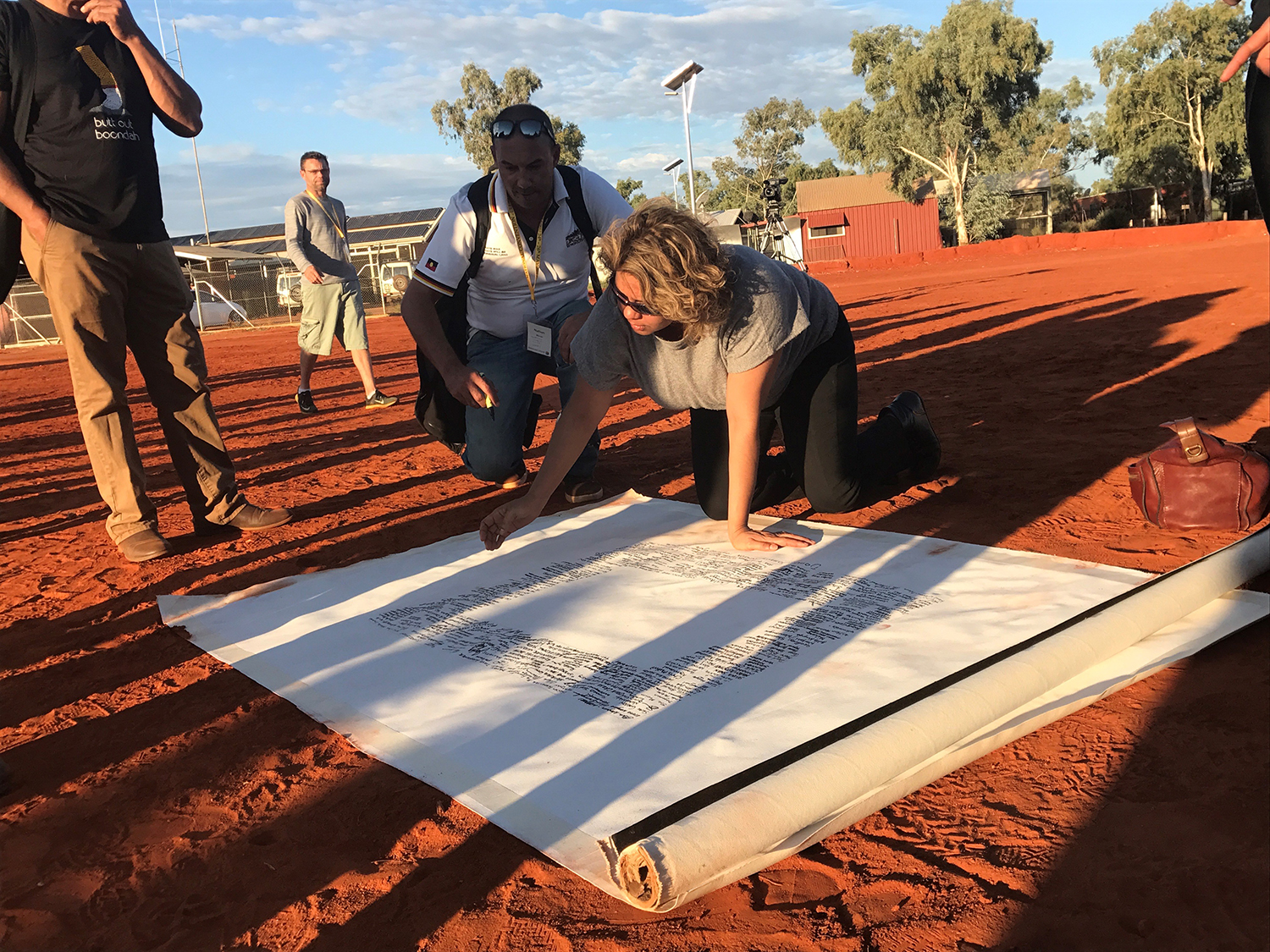
These claims were outlined in the Uluru Statement from the Heart, a document addressed to the Australian people. This has been summarised as: voice, treaty, truth.[56]
The Referendum Council’s final report summarised its findings and supported the call for a First Nations Voice to parliament.[57] Both the Uluru Statement from the Heart and the final report received hostile responses from the Coalition government under Prime Minister Malcolm Turnbull. Parliamentarians attempted to reinvigorate the issue of symbolic recognition in the Australian Constitution, holding a Senate inquiry into constitutional recognition that reported in 2018.
First Nations leaders and activists have been working to gain bipartisan support for a referendum on a First Nations Voice to parliament, after gaining a commitment from the Labor Party in late 2018. The purpose of the First Nations Voice is to provide a constitutionally enshrined voice for First Peoples within the Australian political system, to combat the decades of policy failures and lack of substantive consultation with First Peoples on Indigenous issues.
Conclusions
This chapter focused on the complex nature of Indigenous politics, and the diversity of First Nations across the Australian continent. Historically, governments have failed to take into account the political culture and leadership of First Peoples, preferring policies that are one-size-fits-all and often based on a poor understanding of local priorities. This has led to decades of policy failures, allowing for the continuation of socio-economic disadvantage and denying First Nations’ culture, law, knowledge, experiences and aspirations.
First Peoples have a long history of political activism and resistance, pre-dating the formal recognition of political equality and the right to vote in the 1960s. Adapting to changing circumstances and the restrictions imposed by governments, First Peoples have maintained a number of consistent demands over a long period: land rights, self-determination, treaty and recognition of First Nations sovereignty arising from their continuing obligations and connection to Country. The struggle against institutional racism and social exclusion has also been an enduring theme. Activism has led to significant achievements in terms of social and political change, but First Peoples are forced to work within racialised institutional structures.
Indigenous politics has the potential to change for the better and to move away from the history of failed policy making and denial of First Nations as self-determining political actors. The Uluru Statement from the Heart presents an important opportunity for substantive reform at the national, state and territory level, and the move towards treaty negotiations in certain jurisdictions shows another promising path forward. It is clear that First Peoples in Australia are determined to engage as equals in the political process and work with all Australian citizens to develop a new, more inclusive political culture, reflecting the contemporary realities of First Peoples, settlers and migrants sharing the Australian story. In the words of the Uluru Statement from the Heart, all Australians are invited to ‘walk with us in a movement of the Australian people for a better future’. It is now up to governments to find appropriate ways to respond.
References
Altman, Jon, and Susie Russell (2012). Too much ‘Dreaming’: evaluations of the Northern Territory National Emergency Response Intervention 2007–2012. Evidence Base 3: 1–28. DOI: 10.21307/eb-2012-003
Anderson, Pat, and Rex Wild (2007). Ampe akelyernemane meke mekarle (‘Little children are sacred’): report of the Board of Inquiry into the Protection of Aboriginal Children from Sexual Abuse. Darwin: Department of the Chief Minister, Northern Territory Government.
Appleby, Gabrielle, and Megan Davis (2018). The Uluru statement and the promises of truth. Australian Historical Studies 49(4): 501–9. DOI: 10.1080/1031461X.2018.1523838
Attwood, Bain (2003). Rights for Aborigines. Sydney: Allen & Unwin.
Attwood, Bain, and Andrew Markus (2007). 1967 referendum: race, power and the Australian Constitution, 2nd edn. Canberra: Aboriginal Studies Press.
Australian Bureau of Statistics (ABS) (2018). Estimates of Aboriginal and Torres Strait Islander Australians, June 2016. Cat. No. 3238.0.55.001. Canberra: ABS.
—— (2017). Census of population and housing – counts of Aboriginal and Torres Strait Islander Australians, 2016. Cat. No. 2075.0. Canberra: ABS.
Australian Electoral Commission (AEC) (2017). Electoral milestones for Indigenous Australians. https://www.aec.gov.au/Indigenous/milestones.htm
Behrendt, Larissa (2007). The emergency we had to have. In Jon Altman and Melinda Hinkson, eds. Coercive reconciliation: stabilise, normalise, exit Aboriginal Australia, 15–20. North Carlton, Vic.: Arena Publications.
—— (2003). Achieving social justice. Annandale, NSW: Federation Press.
Burarrwanga, Laklak, Banbapuy Ganambarr, Djawundil Maymuru, Kate Lloyd, Merrkiyawuy Ganambarr-Stubbs, Ritjilili Ganambarr, Sandie Suchet-Pearson and Sarah Wright (2014). Welcome to my Country: seeing the true beauty of life in Bawaka. The Conversation, 15 September. https://theconversation.com/welcome-to-my-country-seeing-the-true-beauty-of-life-in-bawaka-31378
Burgmann, Verity (2003). The Aboriginal movement. In Power, profit and protest, 44–97. Crows Nest, NSW: Allen & Unwin.
Burney, Linda (2018). Taking ‘a rightful place in our own country’: Indigenous self‐determination and the Australian people. Australian Journal of Public Administration 77(S1): S59–S62. DOI: 10.1111/1467-8500.12360
Chesterman, John (2005) Civil rights: how Indigenous Australians won formal equality. St Lucia: University of Queensland Press.
Clark, Jennifer (2008). Aborigines and activism: race, Aborigines and the coming of the sixties to Australia. Crawley: University of Western Australia Publishing.
Dillon, Michael C., and Neil Westbury (2007). Beyond humbug: transforming government engagement with Indigenous Australia. West Lakes, SA: Seaview Press.
Expert Panel on Constitutional Recognition of Indigenous Australians (2012). Recognising Aboriginal and Torres Strait Islander peoples in the Constitution: report of the expert panel. Canberra: Commonwealth of Australia. https://bit.ly/2mlVa58
Falk, Philip, and Gary Martin (2007). Misconstruing Indigenous sovereignty: maintaining the fabric of Australian law. In Aileen Moreton-Robinson, ed. Sovereign subjects: Indigenous sovereignty matters, 33–46. Crows Nest, NSW: Allen & Unwin.
Gardiner-Garden, John (2003). Defining Aboriginality in Australia, Current Issues Brief No. 10. Canberra: Australian Parliamentary Library.
Gilbert, Kevin (1988) Aboriginal sovereignty: justice, the law and land. Captains Flat, NSW: Burrambinga Books.
Gobbett, Hannah (2017). Indigenous parliamentarians, federal and state: a quick guide. Parliamentary Library Research Paper (2017–18). Canberra: Parliament of Australia. https://bit.ly/2Js4vzN
Goodall, Heather (1995). ‘Assimilation begins in the home’: the state and Aboriginal women’s work as mothers in New South Wales, 1900s to 1960s. Labour History 69: 75–101. DOI: 10.2307/27516392
Goot, Murray (2006). The Aboriginal franchise and its consequences. Australian Journal of Politics and History 52(4): 517–61. DOI: 10.1111/j.1467-8497.2006.00432a.x
Goot, Murray, and Tim Rowse (2007). Divided nation? Indigenous affairs and the imagined public. Carlton, Vic.: Melbourne University Publishing.
Haebich, Anna (2008) Spinning the dream: assimilation in Australia 1950–1970. Fremantle, WA: Fremantle Press.
Human Rights and Equal Opportunity Commission (HREOC) (1997). Bringing them home: report of the National Inquiry into the Separation of Aboriginal and Torres Strait Islander Children from their Families. Canberra: Commonwealth of Australia. https://www.humanrights.gov.au/our-work/bringing-them-home-report-1997
Langton, Marcia (2008). Trapped in the Aboriginal reality show. Griffith Review (19): 143–59. https://griffithreview.com/articles/trapped-in-the-aboriginal-reality-show/
Maddison, Sarah (2010). White parliament, black politics: the dilemmas of Indigenous parliamentary representation. Australian Journal of Political Science 45(4): 663–80. DOI: 10.1080/10361146.2010.517180
—— (2009). Black politics: inside the complexity of Aboriginal political culture. Crows Nest, NSW: Allen & Unwin.
McCallum, Kerry, and Holly Reid (2012). Little children and big men: campaigning journalism and Indigenous policy. Australian Journalism Review 34(2): 71–84.
Moran, Robert (2019). ‘This is why I’m doing it’: Brooke Boney on her viral Today moment. Sydney Morning Herald, 7 April. https://www.smh.com.au/entertainment/tv-and-radio/this-is-why-i-m-doing-it-brooke-boney-on-her-viral-today-moment-20190404-p51an9.html
Morgan, Myles, and Jerico Mandybur (2016). Live blog: D-day for Indigenous election candidates. NITV News, 13 June. https://www.sbs.com.au/nitv/nitv-news/article/2016/06/13/d-day-indigenous-election-candidates
O’Neil, Jason (2014). Indigenous constitutional recognition and the politics of distraction. Indigenous Law Bulletin 8(15): 15–7.
Perche, Diana (2019). More First Nations people in parliament matters. Here’s why. The Conversation, 10 May. https://bit.ly/42dVDpZ
—— (2018). ‘Ignore us at your peril, because we vote too’: Indigenous policy. In Anika Gauja, Peter Chen, Jennifer Curtin and Juliet Pietsch, eds. Double disillusion: the 2016 federal election. Canberra: ANU Press.
Read, Peter (2016). With whom do we reconcile? In Sarah Maddison, Tom Clark and Ravi de Costa, eds. The limits of settler colonial reconciliation: non-Indigenous people and the responsibility to engage, 67–81. Singapore: Springer Nature.
Referendum Council (2017). Final report of the Referendum Council. Canberra: Department of the Prime Minister and Cabinet. https://www.referendumcouncil.org.au/final-report.html
Reynolds, Henry (2006). Reviving Indigenous sovereignty? Macquarie Law Journal 6: 5–6.
Royal Commission into the Detention and Protection of Children in the Northern Territory (2017). Final report. Canberra: Australian Government. https://bit.ly/42e4asS
Seed Indigenous Youth Climate Network (n.d.). Our story. https://www.seedmob.org.au/our_story
Smith, Rodney (2001). Australian political culture. Frenchs Forest, NSW: Pearson Education Australia.
Sullivan, Patrick (2011). Belonging together: dealing with the politics of disenchantment in Australian Indigenous policy. Canberra: Aboriginal Studies Press.
Taffe, Sue (2005). Black and white together: FCAATSI, the Federal Council for the Advancement of Aborigines and Torres Strait Islanders, 1958–1973. St Lucia: University of Queensland Press.
Tilmouth, Bruce (1998). Introduction. In Alexis Wright, ed. Take power like this old man here: an anthology of writings celebrating twenty years of land rights in Central Australia 1977–1997. Alice Springs, NT: Jukurrpa Books.
Turner, Pat, and Nicole Watson (2007). The Trojan horse. In Jon Altman and Melinda Hinkson, eds. Coercive reconciliation: stabilise, normalise, exit Aboriginal Australia, 205–12. North Carlton, Vic.: Arena Publications.
United Nations (2007). Declaration on the Rights of Indigenous Peoples, A/RES/61/295. https://www.un.org/development/desa/indigenouspeoples/declaration-on-the-rights-of-indigenous-peoples.html
Victorian Treaty Advancement Commission (2018a). Aboriginal Representative Body. http://victreatyadvancement.org.au/aboriginal-representative-body
—— (2018b). Treaty statewide gathering. Carlton: Victorian Treaty Advancement Commission. https://bit.ly/2kOUnck
Waller, Lisa (2013). It comes with the territory: ‘remote’ Indigenous reporting for mainstream audiences. Australian Journalism Monographs 14(1): 1–42. http://hdl.handle.net/10536/DRO/DU:30060165
Weir, Jessica (2012). Country, native title and ecology. Canberra: ANU Press.
Wolfe, Patrick (2006). Settler colonialism and the elimination of the native. Journal of Genocide Research 8(4): 387–409. DOI: 10.1080/14623520601056240
Yunupingu, Galarrwuy (2016). Rom Watangu. The Monthly, July. https://www.themonthly.com.au/issue/2016/july/1467295200/galarrwuy-yunupingu/rom-watangu
About the authors
Diana Perche is a senior lecturer and academic coordinator at Nura Gili Indigenous Programs Unit at the University of New South Wales, Sydney. Prior to this, she lectured in public policy at Macquarie University in 2005–16, and was the director of the Master of Politics and Public Policy. Diana has worked in a number of policy-related positions, including in the Australian public service, and has a keen interest in the interplay of policy research and policy practice. Her expertise in Australian politics and public policy includes an interest in the use of evidence in policy formulation and a particular focus on Indigenous affairs.
Jason O’Neil is a young Wiradjuri man from Central West NSW. He completed a Bachelor of Laws and a Bachelor of Arts (Honours) in Indigenous Studies at the University of New South Wales, and a Graduate Certificate in Wiradjuri Language, Culture and Heritage at Charles Sturt University. Jason is involved in advocacy and activism on environmental and legal issues affecting First Nations people, and is pursuing a PhD at the University of New South Wales on redefining Indigenous self-determination in Australian public policy.
- Perche, Diana, and Jason O’Neil (2024). Indigenous politics. In Nicholas Barry, Alan Fenna, Zareh Ghazarian, Yvonne Haigh and Diana Perche, eds. Australian politics and policy: 2024. Sydney: Sydney University Press. DOI: 10.30722/sup.9781743329542. ↵
- Goot and Rowse 2007. ↵
- Mabo v Queensland (No 2) [1992] HCA 23 (Mabo). ↵
- Gardiner-Garden 2003. ↵
- Read 2016. ↵
- United Nations 2007, article 33. ↵
- ABS 2017. Note that the Australian Bureau of Statistics recognises that the Census undercounts the Indigenous population, and projected estimates released in 2018 indicate that the population in 2016 was 798,400 or 3.3% of the Australian population. See ABS 2018 for more detail. ↵
- Weir 2012, 3. ↵
- Burarrwanga et al. 2014. ↵
- Wolfe 2006. ↵
- Goodall 1995. ↵
- Haebich 2008. ↵
- Clark 2008. ↵
- Chesterman 2005. ↵
- Attwood and Markus 2007. ↵
- Taffe 2005. ↵
- Attwood 2003. ↵
- Tilmouth 1998. ↵
- Royal Commission into the Detention and Protection of Children in the Northern Territory 2017. ↵
- Yunupingu 2016. ↵
- Maddison 2009. ↵
- Smith 2001, 168–9. ↵
- Seed Indigenous Youth Climate Network n.d. ↵
- AEC 2017; Attwood 2003. ↵
- Goot 2006. ↵
- Gobbett 2017. ↵
- Morgan and Mandybur 2016; Perche 2018. ↵
- Perche 2019. ↵
- Maddison 2010. ↵
- Burney 2018. ↵
- Turner and Watson 2007. ↵
- Behrendt 2007. ↵
- Anderson and Wild 2007. ↵
- Altman and Russell 2012. ↵
- Sullivan 2011, 76. ↵
- Yunupingu 2016, 29. ↵
- Dillon and Westbury 2007. ↵
- Langton 2008. ↵
- Waller 2013. ↵
- Waller 2013. ↵
- McCallum and Reid 2012. ↵
- Moran 2019. ↵
- Burgmann 2003, 44–84. ↵
- Reynolds 2006. ↵
- Maddison 2009, 44–5. ↵
- Coe v Commonwealth [1979] HCA 68; Coe v Commonwealth (No 2) [1993] HCA 42; Mabo [1992] HCA 23. ↵
- Falk and Martin 2007. ↵
- Behrendt 2003. ↵
- For an example of an early discussion of First Nations sovereignty and a draft treaty, see Gilbert 1988. ↵
- Victorian Treaty Advancement Commission 2018a. ↵
- Victorian Treaty Advancement Commission 2018b. ↵
- Section 51(xxvi) of the Australian Constitution (the races power) was amended following the 1967 referendum to provide the Commonwealth with the ability to create legislation specific to First Peoples. ↵
- O’Neil 2014. ↵
- Expert Panel on Constitutional Recognition of Indigenous Australians 2012. ↵
- Referendum Council 2017, 10. ↵
- Appleby and Davis 2018. ↵
- Referendum Council 2017. ↵