
Chapter 6 – Investigate Behaviours in Context
Learning Goals
Use these learning goals to focus your attention, connect new ideas to your own context, and identify practical ways to apply what you learn. In this chapter you can:
- Revisit individual behaviour in context
- Utilise the COM-B model of behaviour change to identify determinants of behaviour
- Summarise key barriers and enablers for change.
Select the Strategies
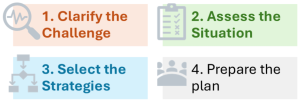 Welcome to the first of two chapters designed to help you select implementation strategies to support the planned improvement.
The focus of this chapter is to investigate individuals’ behaviour in context and use a simple and comprehensive theory to understand what influences key stakeholders’ behaviour.
It is time to focus on individual behaviours of those most impacted by the proposed change. Implementation doesn’t happen simply when change is aligned with the systems and strategies are in place. It requires people to do things differently within systems that support them. Understanding what drives behaviour is essential for selecting the most appropriate implementation strategies.
In this chapter, you will be guided to use behavioural science to understand current practices and to identify perceptions about proposed behaviour changes. From these perspectives, it is possible to identify local and specific barriers and enablers for change.
A structured process is proposed in this and the following chapter to understand current behavioural routines, explore and analyse perceived barriers and enablers to change and develop matching implementation strategies.
Revisit Individual Behaviour in Context
In the first chapter, five core principles were introduced to conceptualise change as a behavioural process. It was highlighted that organisational change requires individuals to change their regular routines and habits. Some individuals will be expected to do more or less of the same thing, others may need to do something completely new, and often, this will require the cessation of certain actions.
In this chapter, the way behaviour is driven by multiple factors will be explored further. The dynamic interplay of capability, opportunity and motivation will be unpacked to justify that information is necessary, but not sufficient for sustained change. The importance of motivation will be explained to demonstrate how it is both complex and contextual.
An understanding of how health systems support relational networks enables deeper exploration of how systems shape behaviour. Specifically, you can create and support learning opportunities to build individuals’ capacity to change.
Some people will be open to change, but unconvinced of its value; others may be uncomfortable with uncertainty. There is a range of different behaviours apparent within any organisation around planned change. This structured process, using behavioural science, explores perceptions of behavioural change in order to match effective implementation strategies.
Define Individual Behaviour
At its core, behaviour refers to purposeful and observable individual actions. Usually, individuals act intentionally in relation to events or stimuli in the systems around them. These actions can be driven by achieving a desired outcome, adjusting to changes or maintaining stability. Behaviour does not occur in isolation. It is influenced by structures, people and processes within the surrounding systems.
The COM-B Model of Behaviour Change
This chapter introduces the COM-B model a simple research informed model that identifies factors influencing individuals’ behaviour. COM-B stands for Capability, Opportunity, and Motivation, and it summarises three interacting components underpinning every behaviour. Individuals must have the capability and opportunity to ‘do something’ and the motivation to ‘do something’ more than anything else. An individual’s capabilities and surrounding opportunities can influence their motivation, and then actually enacting a behaviour alters their capability, opportunity, and motivation. This is represented in the diagram below.
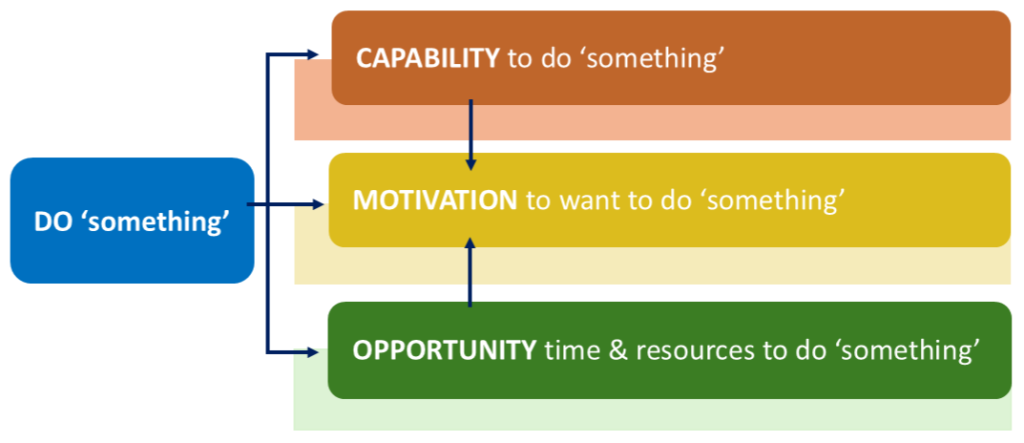
Each of these three components includes two complementary elements. The capability to act requires both the knowledge of what is required and the skills to do it. The opportunity to act is influenced by both physical and social environments. While motivation is often embedded in routines, individuals can also be reflective and intentional in their actions. Sufficient capability, opportunity and motivation is required for every behaviour!
A change in any of these domains can influence whether someone starts, maintains, or abandons a particular behaviour. Multiple factors influence behaviours in the workplace. For example, a clinician may have the knowledge and skills (capability) to complete a new assessment tool but may lack the opportunity if there isn’t enough time. A peer who is unfamiliar with the new tool will avoid using it until they understand how and when to use it. Another clinician who has the knowledge (capability) and time (opportunity) may lack motivation due to past negative experiences or perceived irrelevance of the tool.
Personal Reflection
To familiarise yourself with the COM-B model, use the summary table below to reflect on a recent change in your own behaviour or personal routine. Compare your own underlying capabilities, opportunities and motivation for the change. Evaluate how they all contribute to its sustainability, or not.
COM-B COMPONENTS |
EXPLANATION |
|
| CAPABILITY | Physical | Physical ability, strength, skills, stamina |
| Psychological | Know–how & when to do ‘something’, make decisions | |
| MOTIVATION | Reflective | Goals, intentions, self-efficacy, beliefs, attitudes |
| Automatic | Habits, routines, emotional reactions | |
| OPPORTUNITY | Physical | Physical environment, time, financial resources |
| Social | Social influences, cultural norms, relationships | |
Apply the COM-B Model
To design effective strategies for change, it’s essential to first understand what’s driving or preventing the behaviour you’re trying to influence. The COM-B model offers a practical structure for this analysis by breaking behaviour down into six components across three core domains.
Making sense of behaviour in context
To gain familiarity with the COM-B model in the workplace, aim to understand what is maintaining current behaviours in relation to the problem scenario. Look at patient journey maps and clinical pathways that have been developed with key stakeholders. Consider how individuals’ capabilities enable them to navigate specific physical and social environments.
Explore current practices individually and in discussion with trusted peers:
- Do all individuals have the physical and psychological capabilities to do what is expected?
- For those who are new to the service, do they have the time, space and support to learn and practice new skills?
- Describe how key routines are supported. Check whether individual reflective intentions are aligned with what they do.
Once you have a mental map of key individuals’ behaviours, utilise systems thinking to explore how each component of the COM-B model influences and is influenced by others. These interactions create interesting patterns that shape outcomes.
- Look for positive and negative reinforcing patterns that may represent feedback loops.
- Sometimes, components interact so that small changes can generate substantial effects.
- Look for examples where being able to practice a skill can enhance motivation through increased confidence and self-efficacy.
Identify impacted individuals
From your stakeholder conversations and organisational analysis, identify the individuals who will be required to do things differently from their previous routines and habits. Where possible, highlight these changes on a care pathway, for health professionals to visualise, and in patient journey maps. These proposed behaviour changes become the focus of a more detailed analysis.
Discussions with these individuals about their perspectives on the proposed change are crucial to understanding how system structures and processes influence and support routines.
Collect Data about Perspectives of the Proposed Change
A range of strategies is useful to collect data to understand perspectives about the proposed change. These perspectives can be sourced from the research evidence, local documents, and direct communication with key stakeholders.
Review research evidence
The implementation science literature includes many publications that describe barriers and enablers /facilitators for specific populations and in relation to certain change initiatives. Have a look at the original research evidence you found at the beginning of this process to check if specific barriers and enablers to change were mentioned. If not, search again, using the same terms and add words like barriers, facilitator, enabler to look for specific implementation research. You may also need to broaden your search a bit further. Search for relevant barriers and enablers that could apply to your local organisational context and the specific change proposed. Focus on the literature that looks at the same target population and/or the same or similar practices. Consider using reported barriers and enablers from the literature to guide your local investigation. Some researchers publish their survey tools, and these can guide your own investigations.
If there have been previous project reports or pilot studies undertaken in a similar context, look for summaries of what happened. Look for evidence of barriers and facilitators, even if they are not highlighted as such.
Communicate with stakeholders
Conversations with individuals who are required to change their behaviours are crucial to capture their perceptions about the proposed change. Use the COM-B model as a guiding framework to understand what is likely to drive or prevent the proposed change. Frame interview and discussion questions around the six components using language and examples that are relevant to the specific change in the local workplace.
When little is known about individuals’ perceptions, interviews and focus groups can provide deep and quick clarity. Semi-structured interviews enable immediate conversation around perceptions of the proposed change. Small group discussions utilise the power of group processes to elicit a broad discussion. Good surveys require more detailed knowledge of current perceptions and enable wider distribution.
Personal Reflection
To familiarise yourself with this process, create or role-play a personal conversation with a colleague who has told you they want to walk more, but is unsure how to start. Craft questions similar to those in the table below to understand your colleagues’ perspectives.
Afterwards, reflect on how you have made sense of their capabilities, opportunities, and motivation to change. Initiate a similar conversation with another person to understand how subtle some of these perceptions may be.
COM-B COMPONENTS |
EXAMPLE QUESTIONS |
|
Physical CAPABILITY |
How fit are you? How far can you walk? |
|
Psychological CAPABILITY |
Why is fitness important? What has prompted you to change? |
|
Reflective MOTIVATION |
When can you start to walk? What do you think will change? |
|
Automatic MOTIVATION |
What have you done before? What did you enjoy about it? |
|
Physical OPPORTUNITY |
Do you have good shoes? Where is it best to walk? |
|
Social OPPORTUNITY |
Do you want a coach to help you? Who can walk with you? |
Key investigative questions
Back in the workplace, reframe investigatory questions in the table below to guide conversation about individuals’ perceptions about changing their behaviour in your workplace, to address the important issue. Listen carefully to what is influencing behaviour across the six different components of the COM-B model. Where possible, record these conversations, so you can reflect on what aspects of each individual’s capability, opportunity and motivation are driving or preventing the desired change.
COM-B COMPONENTS |
QUESTIONS TO INVESTIGATE CHANGE |
|
Physical CAPABILITY |
Do you know how to make the change? How easy is it to do? |
|
Psychological CAPABILITY
|
Do you know why, when and what is required for the change? What will help you to decide to change? |
|
Reflective MOTIVATION
|
What are your goals, intentions to change? Do you believe that you can make the change? |
|
Automatic MOTIVATION
|
How does the change fit into usual routines? How do you feel about it? Will it be easy to remember to change? |
|
Physical OPPORTUNITY
|
Do you have space, resources, and time to make this change? |
|
Social OPPORTUNITY
|
Who will support you to make this change? What do your colleagues think about this? |
Identify barriers and enablers
As you interact with and observe these discussions, listen for cues that signal barriers (lack of time, unclear expectations, peer resistance) or enablers (leadership support, prior success, values alignment). Remember that behaviour is always influenced by the structures, relationships, and pressures of the environment.
Summarise Barriers and Enablers for Change
Grouping these insights under the COM-B components helps make sense of diverse feedback and highlights where support is most needed. Complete the table below as accurately as possible around the proposed change.
Summarise individuals’ perspectives, and their key barriers and enablers, for each component.
|
COM-B COMPONENTS |
COLLECTIVE PERSPECTIVE |
BARRIERS |
ENABLERS |
|
Physical CAPABILITY |
Ability and skills |
|
|
|
Psychological CAPABILITY |
Know-how, decisions |
|
|
|
Reflective MOTIVATION |
Goals, intentions |
|
|
|
Automatic MOTIVATION |
Habits, routines |
|
|
|
Physical OPPORTUNITY |
Space, resources, time |
|
|
|
Social OPPORTUNITY |
Support, relationships |
|
|
Different groups of stakeholders may have different challenges and different patterns of barriers and enablers.
Where one team may be unfamiliar with the change and report many capability barriers around learning and understanding what to do differently, another may be struggling with social opportunity barriers, such as a lack of leadership support and recognition.
Identify behavioural determinants
As you document barriers and enablers across each of these six components, look for the determinants of behaviour, that is, the specific factors that need to be addressed for the desired change to occur. Sometimes barriers and enablers reflect both sides of a common issue.
Look for ways that you can remove and /or reduce the effect of these barriers. Explore how the enablers may fit with existing levers for change identified in earlier process mapping. Continue to group these insights under the COM-B components to clarify how specific barriers and enablers relate to individual, social, or structural conditions.
For example:
- A lack of practical know-how suggests limited psychological capability.
- Limited engagement with a new product might influence physical capability
- Time pressures or equipment issues reflect physical opportunity constraints.
- Peer influence or workplace culture might affect social opportunity.
- Beliefs about the value or consequences of change relate to reflective motivation.
- Habits, emotions, or resistance may be signs of automatic motivation at play.
This analysis sharpens your understanding of the challenge of behaviour change and guides the selection of targeted implementation strategies that address the most influential determinants of change. This is the focus of the next chapter.
Navigate the Paradox Between Responsibility and Influence
It’s tempting to assume that if people aren’t changing their behaviour, it’s a matter of compliance or attitude. However, for change in complex health systems, clinicians are often held responsible for implementing improvements, without considering their authority to influence all the conditions that shape behaviour.
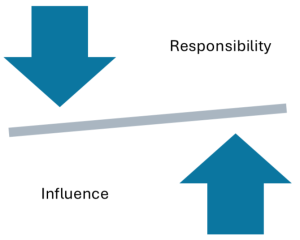
This implementation paradox represents the tension between being accountable for change, but not fully in control of the context in which that change must occur.
Can you understand how to influence what needs to shift around the person, to make new behaviours possible?
Exploring behaviour using the COM-B model allows you to better understand this complexity. It surfaces what influences behaviour and clarifies which factors can be changed through local action and which require broader system shifts. Recognising this paradox empowers you to act more strategically.
Case Scenario: “We Trained Everyone – But Practice Didn’t Change”
Setting:
A regional health service is preparing to implement an AI-assisted imaging platform in its radiology and emergency departments.
Challenge:
The hospital has identified that local workforce shortages were causing delays in the accurate reporting and diagnosis of images.
Initial Action:
A technology company was invited to demonstrate their new AI-assisted imaging platform, which promised to reduce diagnostic delays, improve accuracy, and partially offset workforce shortages by flagging high-risk images for rapid review. The executive team were enthusiastic and gave the senior radiologist responsibility for its introduction.
Weeks later, when the company contacted for a service update, their AI-assisted imaging platform was not being regularly used.
Emerging Tension:
The hospital encountered the Responsibility vs Influence paradox.
The senior radiologist was expected to lead this change, but he didn’t choose the platform, nor could he control staffing levels or technical support. He had focused on teaching all radiologists how to use the platform, assuming it would quickly reduce their time to read and interpret images.
However, a range of behavioural barriers were at play. Some radiologists worried that using AI would erode their professional judgment or replace their roles (reflective motivation). Others felt underprepared to interpret AI output (psychological capability). Nursing and administrative staff expressed concerns about workflow disruptions in an already overstretched environment (physical opportunity). There were also the inevitable technical challenges that nobody seemed able to resolve.
Turning Point:
A locum radiologist emerged as an early adopter for this change. She had used a similar AI-assisted imaging platform in a previous role. She was optimistic and described how this had improved accuracy and decision-making in another regional hospital (automatic motivation and social opportunity). This helped the senior radiologist determine where he could influence his peers’ behaviour.
He organised peer-led demonstrations to build confidence, created space for all staff to voice concerns, and organised reliable technical support. He also advocated with executives for clearer messaging around the role of AI as a support, rather than a replacement, for clinical expertise.
By surfacing and addressing the behavioural barriers within his control, he supported constructive engagement while navigating the structural boundaries of his influence.
Reflection Questions
- How can you identify whether a specific behaviour is constrained by motivation, capability, or opportunity?
- How do you navigate the tension between what you’re responsible for and what you can realistically influence?
Key Takeaways
1. Behaviour change is more challenging than many people realise.
Healthcare staff rarely act in isolation. Their actions are influenced by their knowledge, skills, environment, beliefs, and social norms.
2. The COM-B model provides a practical, structured way to analyse behaviour.
Taking a behavioural lens helps uncover what’s really driving or blocking change. Considering individuals’ capabilities, motivation and opportunities to act allows key barriers to emerge that will impact future plans for change.
3. Barriers & enablers can surface through conversation and be mapped to COM-B.
By asking the right questions and listening for cues, you can identify specific factors that act as barriers and enablers.
Additional Resources & Templates
The COM-B model of behaviour change
- The following website offers a range of useful resources.
- This blog offers a very simple and practical explanation.
- This blog is developed with the authors to explain how to use the COM-B model.
- The seminal academic article that introduced the COM-B model is a complex and challenging read. It introduces the COM-B model, and the Behaviour Change Wheel, which will be introduced in the next chapter. The background is interesting, and the COM-B model is introduced early in this paper.
Understanding Barriers and Enablers for change
- A practical blog about an ideal scenario to gather barriers and enablers.
- The following article summarises how researchers developed a mapping guide to link identified barriers to behaviour change theory. Focus groups were conducted with hospital-based healthcare professionals to identify perceived barriers to the implementation of an early mobilisation intervention for older adults. See table 3 for a summary of barriers to behaviour change organised by capability, opportunity and motivation.
Deeper behavioural analysis
- The Theoretical Domains Framework (TDF) is an integrated theoretical framework synthesised from 128 theoretical constructs (from 33 theories) which were judged most relevant to implementation. It is organised into 14 theoretical domains of constructs that influence behaviour. It is often used in conjunction with COM-B to help analyse barriers and choose implementation strategies.
Available Templates
Access the templates on the author’s From Research to Reality webpage on the Mosaic website:
- Behavioural Observation
- Behavioural Analysis of Proposed Change
The study of how individuals think, act, and make decisions, especially in social and environmental contexts.
A behavioural framework proposing that Capability, Opportunity, and Motivation are required for any Behaviour to occur.
The study of methods and strategies to promote the uptake of evidence-based practices and clinical innovations into routine care.