
Introduction
Guiding Framework for Improvement
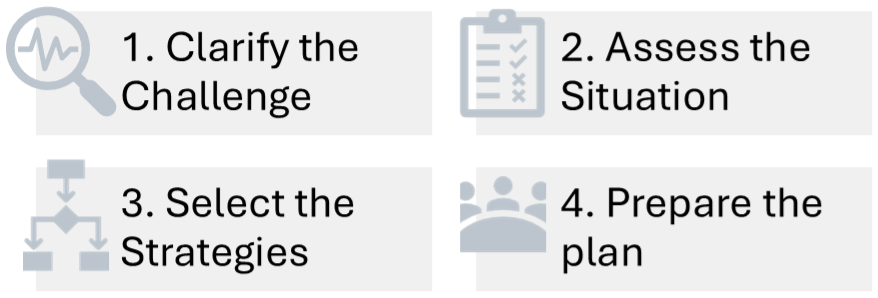
Effective and sustained innovation in healthcare is grounded in core principles structured around a sequence of four actions that, together, create a practical, guiding framework. This logical sequence can be applied widely across different settings. It begins by helping you clarify the challenge, so you can define the real problem and understand why it matters. From there, it is important to assess the situation by examining the behavioural and organisational contexts. This provides alternatives for you to select the strategies that best match the identified needs, barriers, and enablers. Finally, you’ll be guided to prepare the plan and bring everything together into a feasible and adaptive implementation plan.
Core Principles for Change
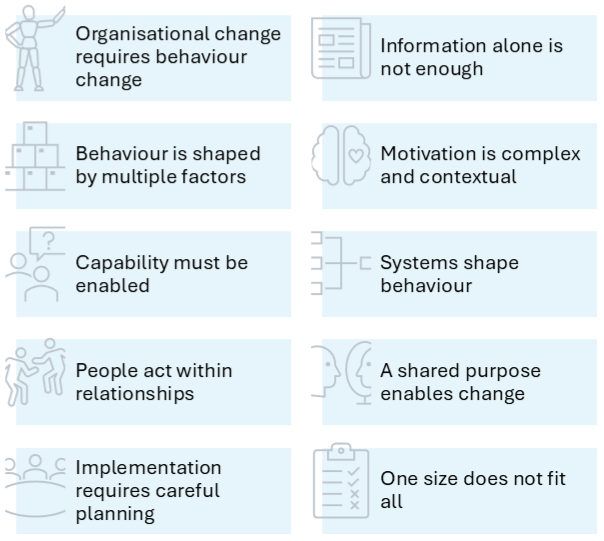
This book is grounded in a set of core principles for change that reflect the complex realities of healthcare improvement. These principles remind us that change is ultimately enacted by people, shaped by the systems in which they work, and sustained through thoughtful planning.
These principles complement the guiding framework, which is comprised of ten ideas that underpin everything in this book. They reflect the patterns I’ve observed across years of implementation work, research, and conversations with clinicians and leaders navigating change in complex systems.
Navigating Through Paradox
Implementation is presented as a sequential and iterative process. At the same time, it is acknowledged that implementation usually occurs within complex healthcare systems, where there are few clear-cut problems or straightforward solutions. Instead, there are often paradoxical situations where two seemingly contradictory truths must be acknowledged and managed. These tensions can be summarised as paradoxes, as opposing ideas that are both true.
Traditional problem-solving tends to eliminate or resolve contradictions. However, in implementation, paradoxes are persistent and often productive. Recognising paradoxes involves a shift in mindset, from trying to ‘fix’ uncertainty to learning how to accommodate it. It can help you to hold competing demands in view, stay responsive to emerging challenges, and design change efforts that are more adaptive, realistic, and sustainable.
At the end of each chapter, a matched paradox is presented as a summary and a practical challenge. Suggestions for how to navigate these tensions are provided to prompt reflection and discussion with peers. These paradoxes are designed to foster curiosity and deep thinking, as naming the tension can help to navigate it more intentionally and with greater compassion.